English
 Español
 tiếng việt
 русский
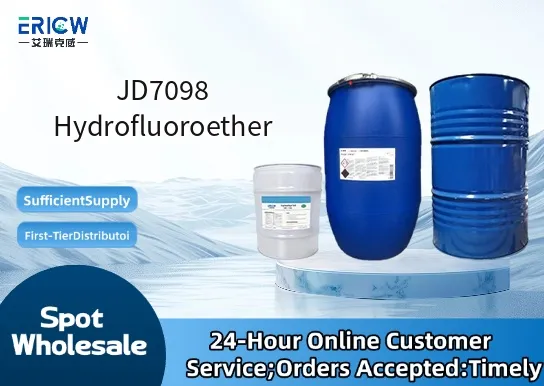
Zero ozone depletion potential (ODP = 0) and low global warming potential (GWP < 15).
Non-flammable under standard atmospheric conditions (ASTM D3278 pass).
Excellent material compatibility with common elastomers, plastics, and metals used in precision cleaning equipment.
Fast-drying, residue-free evaporation with no need for post-rinse or nitrogen blow-off.
Chemically stable and non-reactive toward sensitive electronic components and optical coatings.
Final rinse solvent for high-precision electronics cleaning (e.g., MEMS, sensors, PCB assemblies).
Carrier fluid for vapor degreasing and two-phase cleaning systems.
Low-residue drying agent in medical device manufacturing and sterilization support processes.
Formulation component in specialty coating release agents and temporary protective films.
Cleaning medium for aerospace avionics and optical lens assemblies requiring ultra-low particulate generation.
| Chemical Type | Hydrofluoroether (HFE), branched C6 structure |
| Product Form | Liquid at room temperature |
| Appearance | Clear, colorless, odorless liquid |
| Boiling Point (°C) | ~76–79 °C (at 760 mmHg) |
| Melting Point (°C) | < –100 °C |
| Density (g/cm³ at 20°C) | 1.32–1.35 |
| Refractive Index (nD20) | 1.275–1.285 |
| Regulatory Compliance | REACH registered; TSCA listed; compliant with EU RoHS Directive (2011/65/EU) |
| Common Compatible Systems | Suitability |
| Vapor degreasing equipment (e.g., Precision Cleaning Systems, SMT-type units) | Highly Recommended – Optimized for closed-loop recovery and low emissions |
| Two-tank immersion cleaning systems with ultrasonic agitation | Recommended – Requires temperature control ≤ 45 °C to maintain stability |
| Dispensing systems for precision coating applications | Suitable – Compatible with stainless steel, PTFE, and Viton® wetted parts |
| Automated spray-in-air cleaning stations | Recommended – Low surface tension enables uniform coverage without pooling |
Q1: What is the CAS Registry Number for JD7098 Hydrofluoroether?
A: The CAS number for JD7098 Hydrofluoroether is 1321375-23-2.
Q2: What is the recommended usage concentration when blended with co-solvents?
A: JD7098 is typically used neat (100%) as a final rinse or carrier fluid; when blended (e.g., with low-boiling alcohols), concentrations of 70–95% v/v are common—always validate compatibility and residue testing per application.
Q3: How does JD7098 compare to HFC-43-10mee or other legacy HFEs in terms of environmental profile?
A: JD7098 offers significantly lower GWP (<15) than HFC-43-10mee (GWP ≈ 1,640) and improved hydrolytic stability versus early-generation linear HFEs, supporting longer bath life and reduced disposal frequency.
Q4: Is JD7098 subject to VOC regulations in the U.S. or EU?
A: No—JD7098 is exempt from U.S. EPA VOC regulations (40 CFR §51.100) and classified as a “zero-VOC” substance under EU Paints Directive (2004/42/EC) due to negligible photochemical reactivity.
Q5: Does JD7098 exhibit migration or extractables risk when in contact with silicone-based gaskets or adhesives?
A: Extensive testing shows no measurable migration or extraction from medical-grade silicones (e.g., Dow Corning® MED-4840) after 72-hour exposure at 25 °C; validated per USP <87> and ISO 10993-12 protocols.
Contact With Us:
E-mail: wangxingqiang@ericwchem.com
Have a Questions? Call Us:
Add:
Building A1, Jiete Industrial Park, Huangpu District, Guangzhou City, Guangdong Province, China