English
 Español
 tiếng việt
 русский
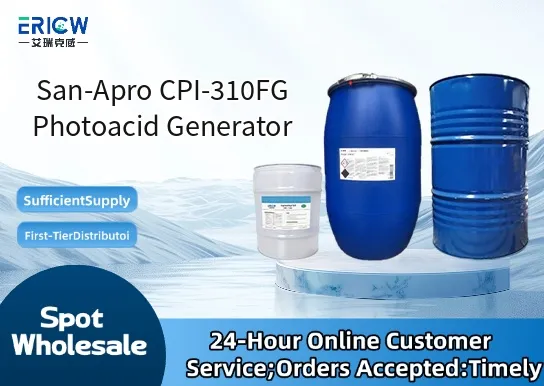
High quantum yield of acid generation under 365 nm (i-line) exposure, enabling efficient lithographic patterning.
Excellent thermal stability up to 180 °C, minimizing premature acid release during pre-bake and post-exposure bake steps.
Low volatility and negligible sublimation at standard handling temperatures, ensuring formulation consistency and shelf-life stability.
High purity (>99.5% by HPLC), with strict control of metal impurities (<10 ppb Na, K, Fe, Ni), critical for semiconductor-grade applications.
Compatible with standard alkaline aqueous developers used in positive-tone chemically amplified resists (CARs).
Front-end-of-line (FEOL) patterning for advanced logic and memory devices at 28 nm and above nodes.
Photoresist formulations for LED and power device fabrication requiring high-resolution i-line compatibility.
Manufacturing of MEMS and microfluidic devices where controlled acid diffusion and low outgassing are essential.
Advanced packaging lithography, including redistribution layer (RDL) and fan-out wafer-level packaging (FOWLP).
Specialty coatings for optical waveguides and photonic integrated circuits (PICs) requiring precise acid-catalyzed crosslinking.
| Chemical Type | Sulfonium salt (triphenylsulfonium perfluorobutanesulfonate) |
| Product Form | White crystalline powder |
| Appearance | Free-flowing, off-white to pale yellow crystals |
| Melting Point | 172–176 °C (determined by DSC, onset) |
| Primary Applications | Chemically amplified positive-tone photoresists for i-line (365 nm) lithography |
| Key Features | High acid strength (H₀ ≈ –12), low diffusion coefficient, minimal PAG decomposition during storage |
| Benefits | Improved resolution, line-edge roughness (LER) control, and process window robustness |
| Regulatory Compliance | REACH registered; RoHS 2015/863 compliant; no SVHCs listed above threshold |
| Common Compatible Systems | Suitability |
| Novolac resin-based CAR formulations | Highly Recommended – Proven compatibility with standard novolac/diazonaphthoquinone (DNQ) hybrid systems and advanced phenolic polymer matrices |
| Acrylic-based chemically amplified resists (e.g., t-BOC deprotection systems) | Recommended – Requires optimization of PAG loading (1.5–3.0 wt%) and PEB conditions for optimal deprotection efficiency |
| Commercial i-line resist platforms (e.g., TOK SAL-6000 series, JSR TMMR series) | Highly Recommended – Demonstrated drop-in replacement capability with equivalent or improved CD uniformity and sensitivity |
| UV-curable epoxy-acrylate hybrid coatings | Suitable – Effective for cationic photopolymerization when blended with appropriate co-initiators and stabilizers |
Q1: What is the CAS Registry Number for San-Apro CPI-310FG?
A: The CAS Number is 1373145-14-5. This identifier corresponds specifically to the triphenylsulfonium perfluorobutanesulfonate composition of CPI-310FG.
Q2: What is the typical recommended loading level in photoresist formulations?
A: Standard loading ranges from 1.0 to 4.0 wt% relative to total solid content, with 2.0–2.5 wt% most common for i-line resists targeting 0.35–0.5 µm resolution. Optimization requires DOE based on resin architecture and process conditions.
Q3: How does CPI-310FG compare to triphenylsulfonium triflate (CPI-210) in terms of acid diffusion and thermal latency?
A: CPI-310FG exhibits lower acid diffusivity (Dₐ ≈ 0.012 µm²/s at 110 °C) and higher thermal latency than CPI-210 due to the bulkier perfluorobutanesulfonate anion, resulting in superior LER performance and reduced pattern collapse risk.
Q4: Is CPI-310FG subject to FDA or EU food contact regulations for use in packaging-related photopolymers?
A: CPI-310FG is not approved for direct food contact under FDA 21 CFR or EU Regulation (EC) No 1935/2004. It is intended solely for industrial semiconductor, MEMS, and electronic packaging applications where migration into consumer goods is precluded by final device encapsulation.
Contact With Us:
E-mail: wangxingqiang@ericwchem.com
Have a Questions? Call Us:
Add:
Building A1, Jiete Industrial Park, Huangpu District, Guangzhou City, Guangdong Province, China