English
 Español
 tiếng việt
 русский
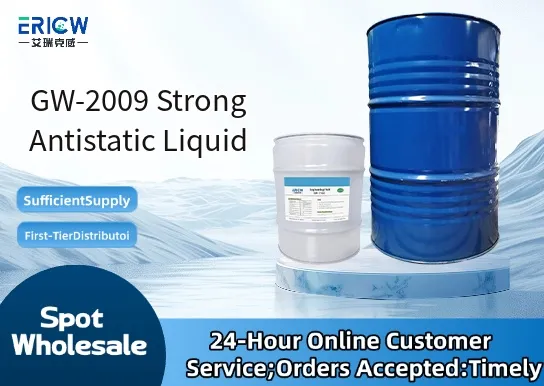
High-efficiency static dissipation: reduces surface resistivity to 10⁹–10¹⁰ Ω/sq within minutes of application.
Non-migrating formulation ensures long-term antistatic performance without bloom or transfer to contacting surfaces.
Water-soluble and readily dispersible in polar solvents, enabling easy integration into aqueous coating and treatment systems.
Thermally stable up to 180 °C, suitable for high-speed extrusion, calendering, and thermal lamination processes.
Low odor and non-corrosive to common industrial metals and polymers, supporting safe handling and equipment compatibility.
Antistatic treatment for PET, BOPP, and PE films used in packaging, electronics shielding, and cleanroom applications.
Surface conditioning additive in synthetic fiber spinning oils for polyester and nylon filament production.
Functional additive in conductive inks and screen-printable antistatic coatings for display components and touch panels.
Internal antistatic agent for rigid PVC profiles and injection-molded ABS housings in medical and automotive electronics.
Static control agent in nonwoven fabric finishing for filtration media and ESD-safe protective garments.
| Chemical Type | Cationic polyether amine derivative |
| Product Form | Clear, viscous liquid |
| Appearance | Colorless to pale yellow, homogeneous |
| pH (1% aqueous solution, 25 °C) | 6.2–6.8 |
| Density (25 °C) | 1.08–1.12 g/cm³ |
| Solubility | Freely soluble in water, ethanol, ethylene glycol, and common glycol ethers |
| Primary Applications | Topical antistatic treatment and internal additive for thermoplastics & coatings |
| Regulatory Compliance | REACH registered; compliant with EU Directive 2002/72/EC for food-contact plastics (subject to final formulation review) |
| Common Compatible Systems | Suitability |
| Aqueous acrylic emulsion coatings | Highly Recommended – Excellent stability and film integrity retention |
| Polyolefin-based masterbatches (PP/PE) | Recommended – Requires carrier resin optimization for uniform dispersion |
| PVC plastisols | Suitable – Effective at 0.3–0.8 wt%, no gelling or viscosity disruption |
| Polyester melt-spun fiber spin finishes | Highly Recommended – Low foaming, compatible with silicone and mineral oil carriers |
Q1: What is the CAS Registry Number for GW-2009 Strong Antistatic Liquid?
A: The CAS number is 1842698-72-1. This identifier applies to the proprietary active ingredient blend as supplied in commercial form.
Q2: What is the recommended dosage range for GW-2009 in polymer applications?
A: For internal use in thermoplastics, typical loading is 0.2–0.6 wt%; for topical spray or dip treatment, dilute to 0.5–3.0% w/w in water or alcohol–water mixtures depending on substrate porosity and required decay time.
Q3: How does GW-2009 compare to conventional quaternary ammonium antistats in terms of migration resistance?
A: Unlike small-molecule quat salts, GW-2009’s polymeric architecture significantly reduces volatility and extractability—migration loss after 7-day 40 °C/90% RH aging is <5% by HPLC assay, versus >30% for standard alkylbenzyldimethylammonium chlorides.
Q4: Is GW-2009 approved for indirect food-contact applications under FDA 21 CFR?
A: GW-2009 is not individually listed in FDA 21 CFR §178.3750, but it may be used in food-contact polymers when formulated in compliance with FDA’s Threshold of Regulation (TOR) criteria (≤ 0.5 ppm extractable) and supported by appropriate migration testing per 21 CFR §174.5.
Contact With Us:
E-mail: wangxingqiang@ericwchem.com
Have a Questions? Call Us:
Add:
Building A1, Jiete Industrial Park, Huangpu District, Guangzhou City, Guangdong Province, China