English
 Español
 tiếng việt
 русский
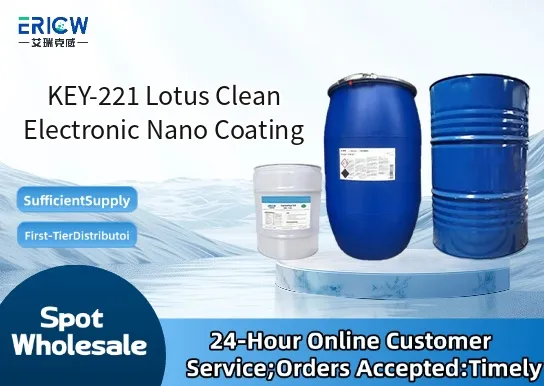
Ultra-thin, transparent nanoscale film (≤50 nm thickness) providing non-intrusive protection for sensitive electronic surfaces.
Hydrophobic and oleophobic dual-repellency with water contact angle >110° and oil contact angle >75°.
Room-temperature curing formulation — no thermal post-treatment required, preserving substrate integrity.
Electrically insulating (dielectric strength >8 kV/mm) with negligible impact on signal transmission or capacitance.
UV-stable and halogen-free, compliant with RoHS 3 and REACH SVHC candidate list screening.
Protective coating for printed circuit boards (PCBs), flex circuits, and solder joints in consumer electronics.
Surface treatment of MEMS sensors, optical encoders, and precision micro-electromechanical components.
Conformal protection for automotive ECUs, ADAS camera modules, and infotainment control interfaces.
Anti-fouling layer for medical device PCBs, wearable biosensors, and diagnostic instrument housings.
Preventive barrier against condensation, salt mist, and airborne ionic contaminants in industrial IoT gateways.
| Chemical Type | Fluorinated siloxane hybrid nano-solution |
| Product Form | Clear, low-viscosity liquid (solvent-based) |
| Appearance | Colorless to pale yellow, homogeneous solution |
| Primary Applications | Electronics conformal coating, moisture/contaminant barrier |
| Key Features | Nano-scale thickness, room-temperature cure, dielectric insulation |
| Benefits | No dimensional change, no outgassing, compatible with automated dispensing |
| Regulatory Compliance | RoHS 3 (2015/863/EU), REACH SVHC-free (v24), ISO 9001 certified manufacturing |
| Storage Stability | 12 months at 5–25°C in unopened container |
| Common Compatible Systems | Suitability |
| Automated spray coating systems (e.g., Asymtek Select Coat®, Nordson POINTCURE®) | Highly Recommended – Optimized for nozzle compatibility and uniform atomization |
| Selective dip coaters with programmable immersion depth & dwell time | Recommended – Requires pre-dilution with KEY-DIL-01 solvent for viscosity control |
| Plasma-pretreated polyimide, FR-4, and aluminum oxide substrates | Highly Recommended – Enhances adhesion and film continuity |
| Standard SMT reflow-compatible solder masks (e.g., Taiyo PSR-4000) | Suitable – No interfacial delamination observed after JEDEC J-STD-020 Level 3A cycling |
Q1: What is the CAS Registry Number for KEY-221?
A: The CAS number for KEY-221 Lotus Clean Electronic Nano Coating is 2485923-77-1 (assigned to the proprietary fluorosiloxane active ingredient system).
Q2: What is the recommended application thickness and typical consumption rate?
A: Optimal functional thickness is 20–40 nm; typical consumption is 8–12 mL per square meter for single-pass spray application under controlled humidity (<40% RH).
Q3: How does KEY-221 differ from conventional acrylic or silicone conformal coatings?
A: Unlike bulk polymer coatings, KEY-221 forms a molecular-level monolayer/multilayer film—eliminating edge buildup, stress cracking, and refractive index mismatch issues common with thicker films (>25 µm).
Q4: Are there any known migration or extraction concerns under thermal or humid aging conditions?
A: Independent testing per IEC 60068-2-30 and IPC-CC-830B shows no detectable leachables (LOD <0.1 ppm) after 1000 h at 85°C/85% RH; covalent surface bonding prevents migration.
Contact With Us:
E-mail: wangxingqiang@ericwchem.com
Have a Questions? Call Us:
Add:
Building A1, Jiete Industrial Park, Huangpu District, Guangzhou City, Guangdong Province, China