English
 Español
 tiếng việt
 русский
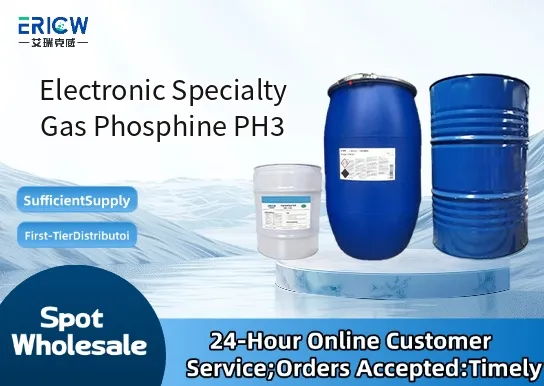
Ultra-high purity (99.999% minimum) with stringent control of metallic impurities (<1 ppb) and moisture (<0.1 ppm).
Manufactured and packaged under inert atmosphere in electropolished stainless-steel cylinders with VCR® fittings to prevent contamination.
Traceable lot documentation including GC-MS analysis, residual gas testing, and full Certificate of Analysis (CoA).
Stabilized formulation with proprietary cylinder passivation to minimize wall adsorption and ensure consistent delivery performance.
Compliant with SEMI F57 (Specification for Phosphine Gas) and ISO 8573-1:2010 Class 1 for particulate and hydrocarbon content.
Dopant source for n-type silicon epitaxy in advanced CMOS and power device fabrication.
Phosphorus precursor in low-pressure chemical vapor deposition (LPCVD) of silicon phosphide (SiP) and doped silicon layers.
Key reagent in metalorganic chemical vapor deposition (MOCVD) for III–V compound semiconductors (e.g., InGaP, GaP).
Plasma-enhanced chemical vapor deposition (PECVD) of phosphosilicate glass (PSG) for interlayer dielectrics.
Ion implantation pre-amorphization and in-situ doping during selective epitaxial growth (SEG).
| Chemical Type | Inorganic hydride, Group V precursor |
| Product Form | Compressed gas (non-liquefied at ambient conditions) |
| Appearance | Colorless, flammable gas with characteristic garlic-like odor |
| Melting Point | −133.8 °C |
| Boiling Point | −87.7 °C |
| Primary Applications | Semiconductor doping, epitaxial growth, CVD/PECVD precursors |
| Key Features | High thermal stability, precise stoichiometric control, low decomposition residue |
| Regulatory Compliance | SEMI F57-1118, OSHA HCS, GHS classified as Acute Toxicity Category 2 (inhalation), Flammable Gas Category 1 |
| Common Compatible Systems | Suitability |
| Applied Materials Centura® & Producer® Platforms | Highly Recommended – Optimized for ultra-low-flow PH₃ delivery with integrated abatement compatibility |
| Lam Research Kiyo® & Vector® Etch/CVD Tools | Recommended – Validated for PH₃-based doping modules with standard gas panels |
| ASM International Epsilon® & A400 Series Reactors | Highly Recommended – Certified for high-purity PH₃ in single-wafer epitaxy applications |
| Tokyo Electron (TEL) Trias® & Picosense® Platforms | Suitable – Compatible with mass flow controllers calibrated for PH₃; requires abatement verification |
Q1: What is the CAS Number for electronic-grade phosphine (PH₃)?
A: The CAS Registry Number for phosphine is 7803-51-2. All electronic-grade PH₃ batches are traceably certified against this identifier per IUPAC and regulatory standards.
Q2: How does PH₃ compare to phosphorus-containing alternatives like TBP (tributylphosphine) or TPP (triphenylphosphine) in semiconductor processes?
A: PH₃ offers superior volatility, lower carbon residue, and direct P incorporation without organic ligand decomposition byproducts—making it preferred for high-resolution dopant profiling and low-temperature epitaxy where carbon contamination must be avoided.
Q3: Is PH₃ subject to export controls or REACH registration?
A: Yes. PH₃ is listed under EU REACH Annex XIV (Sunset Date: 2027) and subject to dual-use export controls (EAR99 / Wassenaar Arrangement Category 1.c.10). Full regulatory support documentation is provided with every shipment.
Q4: Can PH₃ be safely used in systems previously exposed to arsine (AsH₃) or silane (SiH₄)?
A: Cross-contamination risk exists. Dedicated gas lines, manifolds, and abatement systems are strongly recommended. Cylinder changeover requires rigorous purging (≥10 cylinder volumes with ultra-high-purity N₂) and residual As/Si testing per SEMI F21.
Contact With Us:
E-mail: wangxingqiang@ericwchem.com
Have a Questions? Call Us:
Add:
Building A1, Jiete Industrial Park, Huangpu District, Guangzhou City, Guangdong Province, China