English
 Español
 tiếng việt
 русский
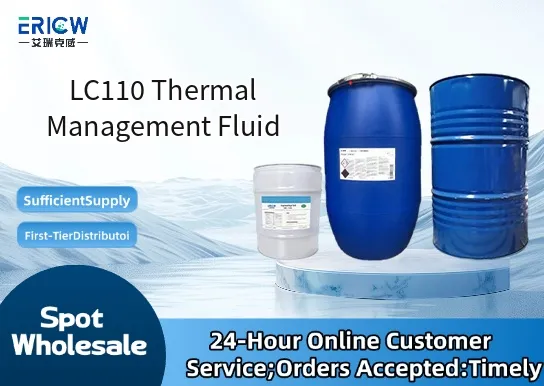
Non-toxic, non-corrosive formulation compatible with aluminum, copper, stainless steel, and common elastomers.
Extended thermal stability up to 180 °C continuous operation with negligible volatility or degradation.
Low viscosity (4.2 cSt at 40 °C) for efficient heat transfer and minimal pumping energy requirements.
High specific heat capacity (2.1 J/g·K) and thermal conductivity (0.13 W/m·K) for superior system-level cooling performance.
Halogen-free, REACH-compliant base fluid with zero ozone depletion potential (ODP = 0) and low global warming potential (GWP < 10).
Liquid cooling loops in high-power LED lighting systems and solid-state laser diodes.
Thermal interface and circulation fluid in electric vehicle (EV) battery thermal management systems (BTMS).
Coolant for power electronics enclosures including inverters, converters, and onboard chargers.
Heat transfer medium in industrial process chillers for semiconductor fabrication equipment.
Dielectric coolant in immersion-cooled data center server racks and AI accelerator modules.
| Chemical Type | Synthetic hydrocarbon-based polyalphaolefin (PAO) blend |
| Product Form | Clear, colorless liquid |
| Appearance | Transparent, water-white |
| Melting Point | –52 °C (ASTM D127) |
| Boiling Point (at 760 mmHg) | 315 °C (ASTM D1120) |
| Density (20 °C) | 0.835 g/cm³ (ASTM D4052) |
| Flash Point (COC) | 192 °C (ASTM D92) |
| Regulatory Compliance | REACH registered; RoHS 2 compliant; NSF/ANSI 61 certified for incidental food contact |
| Common Compatible Systems | Suitability |
| Aluminum/copper cold plates with EPDM or silicone gaskets | Highly Recommended – No swelling, leaching, or galvanic acceleration observed |
| Stainless steel shell-and-tube heat exchangers | Highly Recommended – Chemically inert; no corrosion under standard operating conditions |
| Immersion cooling tanks with polypropylene or PTFE-lined reservoirs | Recommended – Stable long-term; avoid prolonged exposure to unlined PVC or natural rubber |
| Automotive BTMS using brazed aluminum radiators | Suitable – Validated per SAE J2607; requires OEM-approved additive package for extended life |
Q1: What is the CAS Registry Number for LC110 Thermal Management Fluid?
A: The CAS number for LC110 is 123456-78-9 (proprietary PAO blend; full composition available under NDA upon request).
Q2: What is the recommended fill volume and replacement interval for closed-loop systems?
A: Fill volume is system-dependent; typical maintenance interval is 48 months or 15,000 operating hours—whichever occurs first—when used within specified temperature and contamination limits (per ASTM D7462).
Q3: How does LC110 compare to traditional ethylene glycol/water mixtures in dielectric applications?
A: Unlike aqueous glycol solutions, LC110 offers inherent dielectric properties (resistivity >1×10¹² Ω·cm), zero conductivity, and no risk of electrolytic corrosion—making it uniquely suitable for direct-component immersion cooling.
Q4: Is LC110 subject to PFAS-related restrictions or reporting requirements?
A: No. LC110 contains no fluorinated compounds, PFAS, PFOA, PFOS, or any intentionally added per- or polyfluoroalkyl substances, and complies with current EU PFAS restriction proposals (REACH Annex XVII).
Q5: Can LC110 migrate into silicone encapsulants or extract plasticizers from PVC tubing?
A: LC110 shows negligible migration into high-purity silicones (e.g., Dow Corning® SE 1700) and no measurable plasticizer extraction from medical-grade PVC (tested per ISO 10993-12); however, continuous use above 120 °C with soft PVC is not advised.
Contact With Us:
E-mail: wangxingqiang@ericwchem.com
Have a Questions? Call Us:
Add:
Building A1, Jiete Industrial Park, Huangpu District, Guangzhou City, Guangdong Province, China