English
 Español
 tiếng việt
 русский
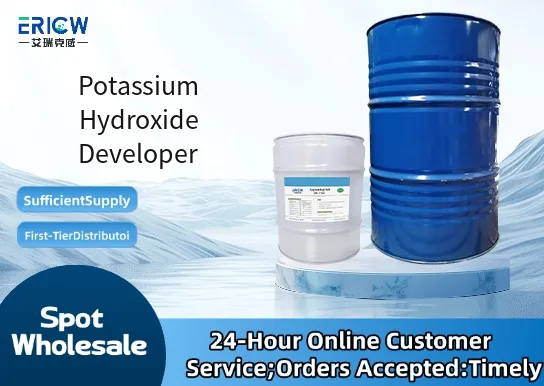
High-purity, low-sodium potassium hydroxide formulation optimized for consistent developer performance.
Controlled particle size distribution ensuring rapid and uniform dissolution in aqueous systems.
Low heavy metal content (<5 ppm) to minimize interference in sensitive electrochemical and imaging processes.
Stabilized against carbonation with nitrogen-blanketed packaging for extended shelf life.
Non-volatile, non-flammable base ideal for industrial-scale alkaline development operations.
Electroplating pre-treatment and etch-resist stripping in PCB manufacturing.
Alkaline development of photopolymer resists in semiconductor lithography.
pH adjustment and catalyst activation in fine chemical synthesis.
Cellulose fiber swelling and mercerization in high-performance textile processing.
Regeneration of anion exchange resins in ultrapure water systems.
| Chemical Type | Potassium hydroxide (KOH), ultra-pure grade |
| Product Form | White granular solid (90–150 mesh) |
| Appearance | Free-flowing, non-caking white granules |
| Assay (KOH basis) | ≥ 99.5% (by titration) |
| Moisture Content | ≤ 0.5% (w/w, Karl Fischer) |
| Primary Applications | Resist development, surface activation, pH control, resin regeneration |
| Key Features | Low chloride (<10 ppm), low sulfate (<5 ppm), low iron (<1 ppm) |
| Regulatory Compliance | REACH registered; compliant with USP/EP excipient guidelines for non-medicinal use |
| Common Compatible Systems | Suitability |
| Photopolymer-based dry film resists (e.g., DuPont Riston®, Asahi HM800) | Highly Recommended – Optimized dissolution rate and edge acuity |
| Ion exchange resin beds (strong base anion resins, Type I & II) | Highly Recommended – Effective OH⁻ regeneration without gel degradation |
| Aqueous alkaline etchants (e.g., KOH + NaOH blends) | Recommended – Fully miscible; maintains stable pH >13.5 |
| Stainless steel (316L) and polypropylene process equipment | Suitable – Non-corrosive at ≤10 wt% concentration below 60°C |
Q1: What is the CAS Number for Potassium Hydroxide Developer?
A: The CAS Registry Number is 1310-58-3, corresponding to anhydrous potassium hydroxide. This product conforms to that identity with verified purity and trace impurity profiles.
Q2: What is the recommended working concentration range for resist development?
A: Typical concentration is 0.5–3.0 wt% in deionized water, adjusted per resist thickness and exposure dose; higher concentrations (>2.0%) require temperature control (20–25°C) to prevent over-development.
Q3: How does this KOH Developer compare to sodium hydroxide (NaOH) alternatives?
A: KOH offers higher solubility, lower eutectic temperature, and reduced risk of sodium-induced haze or crystallization in precision optics and microelectronics applications—critical where ion contamination must be minimized.
Q4: Does this product comply with EU RoHS and REACH SVHC requirements?
A: Yes. It contains no SVHCs above threshold (0.1% w/w), is RoHS-compliant (no restricted heavy metals), and carries full REACH registration (EC No. 215-181-4).
Q5: Is there potential for potassium ion migration into substrates during development?
A: Migration is negligible under standard conditions (≤2 min dwell time, rinse within 15 sec). Post-develop rinse with DI water effectively removes residual K⁺; no leaching observed in glass, silicon, or FR-4 substrates per IPC-TM-650 2.6.27 testing.
Contact With Us:
E-mail: wangxingqiang@ericwchem.com
Have a Questions? Call Us:
Add:
Building A1, Jiete Industrial Park, Huangpu District, Guangzhou City, Guangdong Province, China