English
 Español
 tiếng việt
 русский
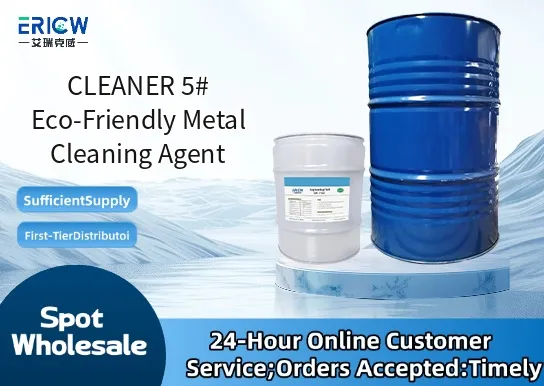
Biodegradable formula compliant with OECD 301B standard for ready biodegradability.
Non-toxic and non-hazardous—no VOCs, no chlorinated solvents, and no heavy metals.
pH-neutral (6.8–7.2) to prevent corrosion on ferrous and non-ferrous metals including aluminum, stainless steel, and copper alloys.
Rapid soil removal of light oils, greases, fingerprints, and particulate residues without aggressive scrubbing.
Low-foaming design optimized for ultrasonic, spray, and immersion cleaning systems.
Precision cleaning of machined components in automotive and aerospace manufacturing.
Pre-treatment cleaning prior to electroplating, anodizing, or powder coating.
Maintenance cleaning of CNC machine tools, fixtures, and jigs.
Cleaning of medical device parts requiring ISO 13485-compatible residue-free processes.
Electronics assembly support—removal of flux residues and handling soils from metal housings and heat sinks.
| Chemical Type | Water-based alkaline surfactant blend with chelating agents |
| Product Form | Concentrated liquid (ready-to-dilute) |
| Appearance | Clear, pale amber liquid, homogeneous and free of sediment |
| pH (1% aqueous solution, 25°C) | 6.9–7.1 |
| Density (25°C) | 1.02–1.04 g/cm³ |
| Primary Applications | Ultrasonic, spray-in-air, and immersion cleaning of metal substrates |
| Key Features | Non-foaming, non-corrosive, non-flammable, phosphate-free |
| Regulatory Compliance | REACH SVHC-free; compliant with EU Ecolabel criteria (2022/105); SDS available per GHS Rev. 10 |
| Common Compatible Systems | Suitability |
| Ultrasonic cleaning tanks (25–60 kHz) | Highly Recommended – Stable performance across temperature range 35–55°C; no foaming or cavitation interference |
| Recirculating spray washers (conveyorized or batch) | Highly Recommended – Excellent soil suspension and rinseability; compatible with stainless steel piping and nozzles |
| Manual immersion soak tanks | Recommended – Effective at ambient temperature; requires agitation for optimal results |
| Robotic part-washing cells with closed-loop filtration | Suitable – Low residue and minimal sump degradation; compatible with polypropylene and EPDM seals |
Q1: What is the CAS Registry Number for CLEANER 5#?
A: CLEANER 5# is a proprietary multi-component formulation; individual ingredients are listed under their respective CAS numbers in Section 3 of the Safety Data Sheet (SDS), but the final product does not carry a single CAS number per IUPAC and EPA guidelines.
Q2: What is the recommended working concentration and temperature range?
A: Typical dilution is 3–8% v/v in deionized or softened water; optimal cleaning occurs between 35–55°C. Higher concentrations do not improve efficacy and may hinder rinsing.
Q3: How does CLEANER 5# compare to solvent-based cleaners like nPB or TCE in terms of cleaning power and safety?
A: CLEANER 5# achieves equivalent removal of light-to-moderate hydrocarbon soils without neurotoxicity, ozone depletion potential (ODP), or workplace exposure limits (OELs). It eliminates explosion risk and reduces PPE requirements while maintaining compatibility with sensitive substrates and elastomers.
Q4: Is CLEANER 5# validated for use in regulated environments such as FDA-regulated facilities or cleanrooms?
A: Yes—validated for ISO Class 7 (10,000) cleanroom use; residue testing per USP <85> (Endotoxin) and ASTM D2621 confirms ≤0.1 µg/cm² non-volatile residue after drying. Full validation support documentation available upon NDA.
Q5: Does CLEANER 5# pose any risk of extractables or leachables when used on medical-grade polymers or elastomers?
A: No adverse extractables observed per USP <661.1> and ISO 10993-12 testing on common materials including silicone, EPDM, and polycarbonate; certified non-interfering with subsequent sterilization cycles (EtO, gamma, steam).
Contact With Us:
E-mail: wangxingqiang@ericwchem.com
Have a Questions? Call Us:
Add:
Building A1, Jiete Industrial Park, Huangpu District, Guangzhou City, Guangdong Province, China