English
 Español
 tiếng việt
 русский
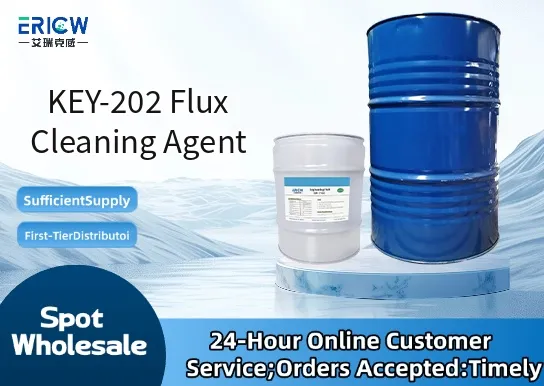
Non-chlorinated, low-VOC formulation compliant with global environmental regulations.
Fast-evaporating solvent blend optimized for residue removal without damaging sensitive substrates.
Non-corrosive to copper, solder alloys, and common PCB laminates including FR-4 and polyimide.
Low surface tension ensures effective penetration into fine-pitch SMT assemblies and under components.
Odor-reduced formula enhances workplace safety and operator comfort during manual or spray cleaning.
Post-reflow cleaning of no-clean and rosin-based flux residues in electronics manufacturing.
Cleaning of stencil apertures and squeegee blades in SMT printing processes.
Removal of ionic and non-ionic contaminants from high-reliability aerospace and medical PCBAs.
Spot cleaning of rework areas prior to conformal coating or final inspection.
Compatibility testing support for new flux formulations in R&D laboratories.
| Chemical Type | Hydrocarbon-alcohol co-solvent blend |
| Product Form | Liquid (ready-to-use) |
| Appearance | Clear, colorless liquid |
| Odor | Mild, characteristic hydrocarbon-alcohol note |
| Primary Applications | Flux residue removal, ionic contamination control, precision electronics cleaning |
| Key Features | Non-ozone depleting, non-halogenated, non-flammable (flash point > 60°C) |
| Benefits | Reduced drying time vs. aqueous systems; no post-rinse required; compatible with automated vapor degreasers |
| Regulatory Compliance | REACH SVHC-free; RoHS-compliant; Prop 65 listed substances absent |
| Common Compatible Systems | Suitability |
| Batch immersion cleaning tanks | Highly Recommended – Stable performance across temperature range 20–50°C |
| Conveyorized spray-in-air cleaners | Recommended – Optimized nozzle pressure and dwell time required for full coverage |
| Vapor degreasing systems (with modified condensing zone) | Suitable – Requires minor cold trap adjustment due to moderate volatility |
| Ultrasonic cleaning baths (low-frequency, <40 kHz) | Recommended – Effective with 3–5 minute cycle; avoid prolonged exposure above 55°C |
Q1: What is the CAS Registry Number for KEY-202?
A: KEY-202 is a proprietary multi-component formulation; individual CAS numbers are not assigned. Full compositional disclosure is available under NDA via Material Disclosure Statement (MDS-KEY202).
Q2: What is the recommended usage concentration and contact time?
A: KEY-202 is supplied as a ready-to-use liquid. Typical contact time is 30–90 seconds at room temperature; extended dwell (>120 sec) is not required and may increase evaporation loss without added benefit.
Q3: How does KEY-202 compare to traditional terpene-based cleaners?
A: KEY-202 offers faster evaporation, lower material cost per cycle, and broader compatibility with plastic housings versus d-limonene cleaners. It also avoids the stability and oxidation issues associated with terpenes.
Q4: Does KEY-202 leave any extractable residue that could interfere with ion chromatography testing?
A: No. When used per recommended parameters and allowed to fully evaporate (≥2 min ambient air dry), KEY-202 leaves no detectable ionic or non-volatile residue per IPC-TM-650 2.3.25 and J-STD-001E Annex B.
Q5: Is KEY-202 certified for use in Class 3 electronics per IPC-A-610?
A: Yes. KEY-202 is qualified per IPC-A-610 Section 10.3 for cleaning of Class 3 assemblies when validated within the user’s specific process (including equipment, dwell time, and drying method).
Contact With Us:
E-mail: wangxingqiang@ericwchem.com
Have a Questions? Call Us:
Add:
Building A1, Jiete Industrial Park, Huangpu District, Guangzhou City, Guangdong Province, China