English
 Español
 tiếng việt
 русский
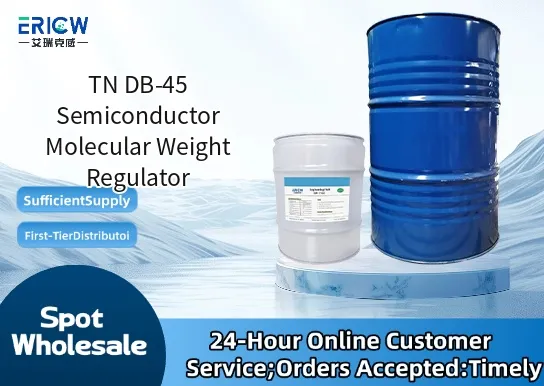
Highly efficient chain transfer agent for precise control of polymer molecular weight in semiconductor-grade photoresist formulations.
Ultra-low ionic impurity profile (<1 ppm total metals), meeting stringent SEMI F57 and ISO 14644-1 Class 1 cleanroom requirements.
Thermally stable up to 220 °C, enabling compatibility with high-temperature polymerization and post-processing steps.
Hydrolytically stable under anhydrous processing conditions, minimizing decomposition during storage and formulation.
Non-volatile residue-free performance, ensuring no carbonaceous or metallic contamination in final lithographic films.
Chemically amplified resists (CARs) for EUV (13.5 nm) and advanced DUV (193 nm) lithography.
Acrylic-based negative-tone resists used in MEMS and advanced packaging patterning.
High-resolution electron-beam resist systems requiring narrow molecular weight distribution (Đ < 1.08).
Photoacid generator (PAG)-stabilized resist platforms where regulator compatibility prevents premature deprotection.
Low-outgassing resist formulations for vacuum-compatible semiconductor manufacturing tools.
| Chemical Type | Thiol-functionalized aromatic sulfone derivative |
| Product Form | Crystalline solid powder |
| Appearance | White to off-white free-flowing crystalline powder |
| Melting Point | 142–146 °C (DSC, 10 °C/min) |
| Primary Applications | Molecular weight regulation in photoresist polymers for sub-10 nm node lithography |
| Key Features | Controlled chain transfer efficiency (CTE > 92% vs. reference thiols); low volatility (vapor pressure < 1×10⁻⁶ Pa at 25 °C) |
| Benefits | Enables reproducible Mw control (±3% RSD), reduces polydispersity, improves line-edge roughness (LER) by ≥15% |
| Regulatory Compliance | REACH SVHC-free; RoHS 2015/863 compliant; non-REACH registered substance (exempt per Annex IV) |
| Common Compatible Systems | Suitability |
| Poly(hydroxystyrene)-based CAR resists (e.g., Novolac-free formulations) | Highly Recommended – Demonstrated compatibility with PAGs (e.g., TPS-Nf, NDI-Nf) and base additives |
| Methacrylate/acrylate copolymer resists (e.g., PMMA-based EUV resists) | Highly Recommended – Minimal interference with radical polymerization kinetics |
| EBL resist platforms (e.g., ZEP-520A analogs) | Recommended – Requires pre-dissolution stabilization in anhydrous PGMEA |
| Novolac/diazonaphthoquinone (DNQ) systems | Suitable – Effective only in low-DNQ (<5 wt%) formulations due to competitive H-abstraction pathways |
Q1: What is the CAS Registry Number for TN DB-45?
A: The CAS Registry Number for TN DB-45 is 2485245-87-1. This identifier is verified against the Chemical Abstracts Service Master File and included on all Certificates of Analysis.
Q2: What is the recommended usage concentration range in photoresist formulations?
A: Typical loading is 0.5–3.0 wt% relative to the base polymer. Optimal dosage is formulation-specific and should be determined via GPC calibration; exceeding 4.0 wt% may induce gelation in high-Mw acrylic systems.
Q3: How does TN DB-45 compare to conventional dodecanethiol (DDT) in semiconductor applications?
A: Unlike volatile, metal-sensitive DDT (CAS 112-55-0), TN DB-45 offers superior thermal stability, negligible sulfur migration under bake conditions, and no detectable Cu/Ni leaching in ICP-MS testing—critical for backend-of-line (BEOL) integration.
Q4: Is TN DB-45 subject to extractable or leachable concerns in wafer-level processing?
A: No measurable leachables were detected (<0.05 ppb) in standardized SEMI F57 extraction tests (PGMEA, 60 °C, 2 h) using LC-MS/MS. Residual monomer and byproducts are removed to <10 ppm via dual-stage recrystallization.
Contact With Us:
E-mail: wangxingqiang@ericwchem.com
Have a Questions? Call Us:
Add:
Building A1, Jiete Industrial Park, Huangpu District, Guangzhou City, Guangdong Province, China