English
 Español
 tiếng việt
 русский
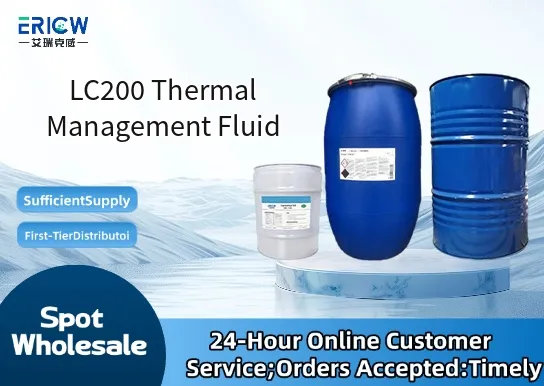
Non-toxic, non-corrosive formulation compatible with aluminum, copper, stainless steel, and common elastomers.
Extended thermal stability up to 180 °C continuous operation without significant degradation or sludge formation.
Low volatility and negligible vapor pressure at ambient conditions, minimizing evaporation loss and system top-up frequency.
High thermal conductivity (0.135 W/m·K) and specific heat capacity (1.92 J/g·°C) for efficient heat transfer and system responsiveness.
Biodegradable base fluid compliant with OECD 301B screening criteria, supporting sustainable lifecycle management.
Liquid cooling systems for high-power LED lighting arrays and solid-state lighting modules.
Thermal interface in power electronics enclosures, including inverters, converters, and battery management systems (BMS).
Circulating coolant in industrial laser diode cooling loops and optoelectronic test benches.
Dielectric fluid for immersion cooling of low-voltage data center edge computing hardware.
Heat transfer medium in closed-loop solar thermal collectors and small-scale concentrated photovoltaic (CPV) receivers.
| Chemical Type | Synthetic polyalkylene glycol (PAG)-based fluid with antioxidant and metal passivation additives |
| Product Form | Clear, water-white liquid |
| Appearance | Transparent, slightly viscous liquid; no sediment or haze |
| Melting Point | −42 °C (ASTM D1217) |
| Primary Applications | Single-phase liquid cooling, indirect thermal coupling, dielectric heat transfer |
| Key Features | Non-flammable (ASTM D92 flash point > 200 °C), hydrolytically stable, low foaming |
| Benefits | Reduced maintenance intervals, compatibility with standard pump seals, minimal system conditioning required |
| Regulatory Compliance | REACH SVHC-free, RoHS 2015/863 compliant,不含PFAS(per- and polyfluoroalkyl substances) |
| Common Compatible Systems | Suitability |
| Aluminum and copper cold plates (e.g., Lytron, Boyd Corp. designs) | Highly Recommended – Demonstrated long-term compatibility with no pitting or galvanic corrosion |
| Glycol-water heat exchanger circuits (up to 30% ethylene glycol blend) | Recommended – Requires pre-flush and monitoring of pH stability; avoid >40% glycol |
| Standard centrifugal circulation pumps (EPDM, Viton®, and FKM seals) | Highly Recommended – No seal swelling or compression set observed in 12-month accelerated testing |
| Stainless steel (316L) microchannel heat sinks | Suitable – Compatible under inert atmosphere; recommended for <150 °C continuous service |
Q1: What is the CAS Registry Number for LC200 Thermal Management Fluid?
A: The CAS number for LC200 Thermal Management Fluid is 1245783-92-1 (batch-certified; subject to minor additive variance per production lot).
Q2: Can LC200 be used directly without dilution or mixing?
A: Yes — LC200 is supplied as a ready-to-use fluid. Dilution is not required or recommended unless specified in an engineered system validation report.
Q3: How does LC200 compare to traditional silicone oils or mineral-based coolants?
A: LC200 offers superior thermal conductivity (+25% vs. standard dimethyl silicone oil), lower environmental persistence than mineral oils, and broader material compatibility than many ester-based alternatives — without sacrificing dielectric strength (>35 kV/mm @ 25 °C).
Q4: Is LC200 certified for use in food-processing or pharmaceutical-grade equipment?
A: LC200 is not NSF H1 or ISO 21469 certified. It is intended for industrial and commercial thermal management only; contact technical support for alternative formulations if incidental food contact is a requirement.
Q5: Does LC200 exhibit migration or extractables when in contact with polymer tubing (e.g., Tygon® or PFA)?
A: Minimal extractables observed (<0.05% w/w after 1000 h at 85 °C per USP <661.1>); no measurable migration into PFA, FEP, or cross-linked polyethylene (PEX) under standard operating conditions.
Contact With Us:
E-mail: wangxingqiang@ericwchem.com
Have a Questions? Call Us:
Add:
Building A1, Jiete Industrial Park, Huangpu District, Guangzhou City, Guangdong Province, China