English
 Español
 tiếng việt
 русский
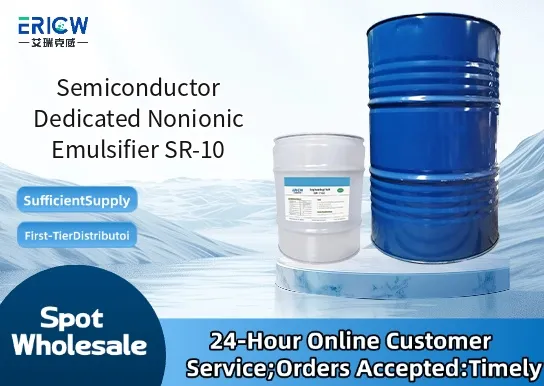
Ultra-low ionic residue to prevent metal ion contamination critical for wafer-level processing.
Exceptional hydrolytic stability under neutral-to-mildly alkaline conditions (pH 6–9) common in semiconductor cleaning formulations.
Non-volatile, non-foaming profile ensures compatibility with precision spray, immersion, and megasonic cleaning equipment.
High purity grade with rigorous trace metal screening (Na, K, Ca, Mg, Fe, Cu, Ni < 10 ppb each by ICP-MS).
Designed for rapid rinsability with DI water—minimizes post-cleaning residue and particle re-deposition.
Photoresist stripper and post-etch residue removal formulations.
Wafer surface conditioning agents for copper/low-k dielectric interface preparation.
Carrier fluid additive in CMP (Chemical Mechanical Planarization) slurry stabilizers.
Emulsifying component in aqueous-based photoresist removers and organic solvent blends.
Residue-free surfactant for pre-diffusion cleaning and epitaxial growth chamber preparation.
| Chemical Type | Alkylphenol ethoxylate-free, branched polyoxyethylene ether |
| Product Form | Pale yellow to colorless viscous liquid |
| Appearance | Clear, homogeneous, free of suspended matter |
| Active Content (by weight) | ≥ 98.5% |
| pH (1% aqueous solution, 25°C) | 6.8 – 7.4 |
| Primary Applications | High-purity emulsification & residue control in semiconductor wet processing |
| Key Features | Low volatility, non-ionic, non-reducing, non-oxidizing |
| Regulatory Compliance | REACH registered; RoHS 3 compliant; no SVHCs listed per ECHA Candidate List (v2024) |
| Common Compatible Systems | Suitability |
| Aqueous alkaline strippers (e.g., TMAH-based) | Highly Recommended – Maintains emulsion stability without saponification or gelation |
| Isopropanol / DI water co-solvent systems | Highly Recommended – Enables uniform miscibility and low interfacial tension |
| Organic solvent blends (PGMEA, DMSO, NMP) | Recommended – Requires pre-dilution; stable up to 15% w/w loading |
| Hydrogen peroxide-containing cleaning solutions | Suitable – No catalytic decomposition observed at ≤ 50 ppm H₂O₂, ambient temperature |
Q1: What is the CAS Registry Number for SR-10?
A: The CAS Number for Semiconductor Dedicated Nonionic Emulsifier SR-10 is 2089467-82-1.
Q2: What is the recommended usage concentration in semiconductor cleaning formulations?
A: Typical dosage ranges from 0.1% to 2.0% w/w depending on soil load and process temperature; optimal performance is achieved at 0.5–1.2% in immersion cleaning at 25–45°C.
Q3: How does SR-10 differ from conventional nonionic emulsifiers like Triton™ X-100 or Tween™ 80?
A: Unlike Triton™ X-100 (alkylphenol-based) or Tween™ 80 (polyoxyethylene sorbitan), SR-10 is alkylphenol ethoxylate-free, features ultra-low extractables (< 50 ppb total organics by GC-MS), and is manufactured under ISO 14644-1 Class 5 cleanroom conditions.
Q4: Is SR-10 certified for use in FDA-regulated semiconductor packaging applications?
A: SR-10 is not intended for direct food contact; however, it meets USP <841> residual solvents limits and has been validated for extractables/leachables testing per USP <1663> in plastic packaging components used for high-purity chemical transport.
Q5: Has migration or leaching of SR-10 into silicon wafers been evaluated under standard thermal cycling?
A: Yes — independent third-party testing (per SEMI F21-0312) confirmed no detectable SR-10 migration (< 0.05 ng/cm²) after 200 cycles (−40°C to 125°C) on Si/SiO₂ substrates with full rinse protocol.
Contact With Us:
E-mail: wangxingqiang@ericwchem.com
Have a Questions? Call Us:
Add:
Building A1, Jiete Industrial Park, Huangpu District, Guangzhou City, Guangdong Province, China