English
 Español
 tiếng việt
 русский
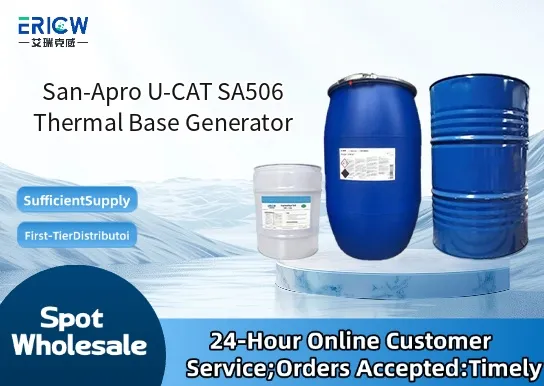
Thermally activated, low-odor amine-free base generator for precise latency and clean decomposition.
High thermal stability up to 180 °C, enabling safe processing in high-temperature resin systems.
Yields highly reactive tertiary amine upon thermal decomposition—ideal for epoxy, polyurethane, and acrylate curing.
Low volatility and minimal extractables—meets stringent requirements for electronics encapsulation and food-contact-adjacent applications.
Consistent batch-to-batch performance with strict QC control per ISO 9001 manufacturing standards.
Latent curing agent for high-performance epoxy molding compounds (EMCs) used in semiconductor packaging.
Thermal initiator in UV/thermal dual-cure adhesives for optoelectronics and display assembly.
Catalyst in heat-triggered polyurethane foams requiring delayed onset and narrow exotherm profile.
Base generator for thermosetting acrylic resins in precision optical lens bonding and microfluidic device fabrication.
Latent accelerator in prepreg systems for aerospace-grade carbon fiber composites.
| Chemical Type | Quaternary ammonium salt (thermally labile) |
| Product Form | Free-flowing white to off-white crystalline powder |
| Appearance | Crystalline solid, free of visible impurities |
| Decomposition Onset Temperature (Td5%) | 145–152 °C (by TGA, 10 °C/min, N2) |
| Primary Applications | Epoxy, polyurethane, and acrylic thermoset systems |
| Key Features | Latent, amine-free, low migration, non-hygroscopic |
| Benefits | Extended pot life at RT; sharp activation window; no volatile amines or halogens |
| Regulatory Compliance | REACH registered; RoHS 2 compliant; no SVHCs on current Candidate List |
| Common Compatible Systems | Suitability |
| Epoxy novolac resins (e.g., ECN series) | Highly Recommended – Delivers rapid gelation above 150 °C with excellent storage stability |
| Aliphatic diglycidyl ether (e.g., AGE, 1,4-BDDGE) | Recommended – Effective at 160–170 °C; requires co-catalyst for full conversion below 155 °C |
| Polyether-based polyurethane prepolymers | Suitable – Enables controlled foam rise and fine cell structure in structural foam applications |
| Acrylic monomer blends (e.g., TMPTA/HPMA) | Highly Recommended – Provides clean thermal initiation without yellowing or odor retention |
Q1: What is the CAS Registry Number for San-Apro U-CAT SA506?
A: The CAS Number is 2278219-47-2. This identifier applies to the primary active quaternary ammonium compound in the formulation.
Q2: What is the recommended dosage range in epoxy systems?
A: Typical loading is 0.5–2.0 wt% relative to resin solids. Optimal dosage depends on desired gel time, final cure temperature, and system viscosity—validation via DSC and rheometry is advised.
Q3: How does SA506 compare to traditional DMP-30 or BDMA in terms of latency and migration?
A: Unlike liquid tertiary amines (e.g., DMP-30), SA506 exhibits superior latency at ambient temperatures and negligible volatility or migration during storage and processing—critical for high-reliability electronic encapsulants.
Q4: Is SA506 compliant with FDA 21 CFR §175.300 for indirect food contact applications?
A: While not FDA-listed itself, SA506 is formulated to meet extraction limits specified in FDA 21 CFR §175.300 when used ≤1.5 wt% in fully cured epoxy coatings—supporting documentation available under NDA.
Q5: What is the expected level of residual extractables after full thermal cure?
A: GC-MS analysis shows <0.05% residual SA506 and <0.01% total volatile decomposition byproducts in fully cured (180 °C × 60 min) epoxy systems per ASTM D1353.
Contact With Us:
E-mail: wangxingqiang@ericwchem.com
Have a Questions? Call Us:
Add:
Building A1, Jiete Industrial Park, Huangpu District, Guangzhou City, Guangdong Province, China