English
 Español
 tiếng việt
 русский
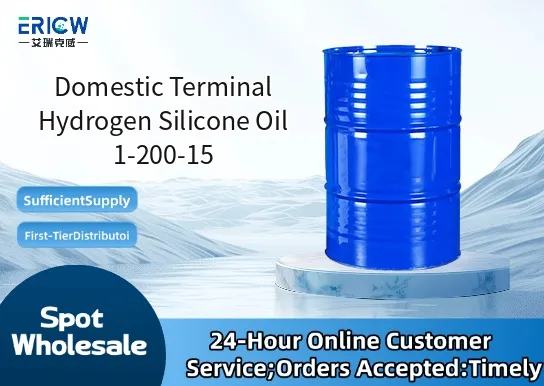
Terminal hydrogen functionality enables controlled hydrosilylation reactivity for precise crosslinking in silicone formulations.
Low volatility and high thermal stability support processing at elevated temperatures without significant weight loss or degradation.
Excellent hydrophobicity and surface migration resistance ensure long-term performance in moisture-sensitive applications.
Consistent molecular weight distribution (MW ~200 g/mol) ensures reproducible rheology and compatibility across batch production.
Non-toxic, non-irritating profile compliant with industrial handling safety standards for routine manufacturing use.
Hydrosilylation-curable liquid silicone rubber (LSR) base component for precision molded parts.
Crosslinker in heat-cured silicone elastomer systems for automotive gaskets and seals.
Surface modifier for silicone release coatings on paper, film, and foil substrates.
Reactive diluent to adjust viscosity and enhance network density in platinum-catalyzed silicone gels.
Functional additive in specialty lubricants requiring oxidative stability and low surface tension.
| Chemical Type | Linear polydimethylsiloxane (PDMS) with terminal Si–H groups |
| Product Form | Clear, colorless liquid |
| Appearance | Transparent, mobile oil with slight characteristic odor |
| Melting Point | Below −40 °C (remains liquid at ambient temperature) |
| Primary Applications | Hydrosilylation crosslinking, LSR formulation, release coating modifier |
| Key Features | Controlled Si–H content (~15 wt%), low viscosity (~15 cSt @ 25 °C) |
| Benefits | Enables rapid, catalyst-efficient curing; improves mechanical integrity of cured networks |
| Regulatory Compliance | REACH registered; no SVHC substances above threshold; RoHS compliant |
| Common Compatible Systems | Suitability |
| Platinum-based LSR formulations | Highly Recommended – Excellent reactivity match and network uniformity |
| High-consistency rubber (HCR) masterbatches | Recommended – Requires pre-dispersion; effective at ≤5 phr loading |
| Silicone emulsion systems (anionic/cationic) | Suitable – Stable under pH 5–9; avoid strong alkaline conditions (>pH 10) |
| Organic solvent-based coatings (e.g., toluene/xylene blends) | Highly Recommended – Fully miscible; enhances film leveling and substrate wetting |
Q1: What is the CAS Registry Number for Domestic Terminal Hydrogen Silicone Oil 1-200-15?
A: The CAS number is 63148-62-9 (representative for linear PDMS with terminal Si–H functionality; exact identity confirmed via batch-specific GC-MS and ¹H-NMR).
Q2: What is the recommended dosage range when used as a crosslinker in LSR systems?
A: Typical dosage is 0.5–3.0 parts per hundred rubber (phr), adjusted based on Si–H : vinyl molar ratio (target 1.0–1.3:1) and desired cure speed/hardness.
Q3: How does it differ from standard dimethyl silicone oil (e.g., Dow Corning 200 Fluid)?
A: Unlike inert dimethyl silicone oils, this grade contains reactive terminal Si–H bonds, enabling covalent network formation—making it a functional crosslinker rather than a passive diluent or release agent.
Q4: Is extraction or migration into food-contact materials a concern under EU Regulation (EC) No 1935/2004?
A: When fully cured in compliant silicone matrices, residual monomer and extractables remain below EU Plastics Regulation (EU) No 10/2011 SML limits; full compliance documentation available upon request.
Contact With Us:
E-mail: wangxingqiang@ericwchem.com
Have a Questions? Call Us:
Add:
Building A1, Jiete Industrial Park, Huangpu District, Guangzhou City, Guangdong Province, China