English
 Español
 tiếng việt
 русский
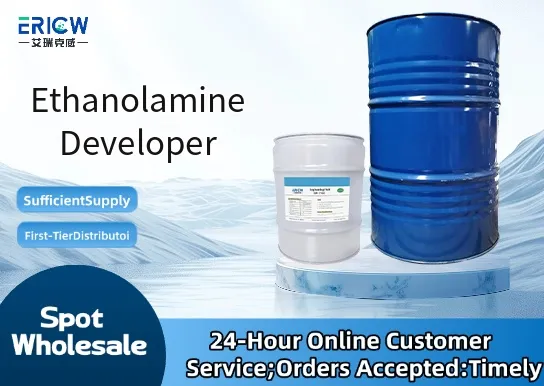
Highly effective alkaline developer for high-contrast, low-fog imaging systems.
Excellent solubility in water and common organic co-solvents (e.g., ethanol, ethylene glycol).
Controlled volatility and low vapor pressure ensure stable bath life and reduced workplace exposure.
Minimal metal ion chelation, preserving the integrity of aluminum-based printing plates and anodized rollers.
Biodegradable backbone with favorable environmental profile compared to traditional alkali developers.
Waterless and conventional offset lithographic plate development.
Electrophotographic (xerographic) toner formulation and developer component in copier/printer cartridges.
Photopolymer flexographic printing plate processing.
Chemical amplification in photoresist development for semiconductor microlithography (non-critical layers).
Specialty cleaning formulations for precision optics and microelectronics substrates.
| Chemical Type | Alkanolamine (2-Aminoethanol derivative) |
| Product Form | Liquid concentrate (aqueous solution, 70–85% w/w) |
| Appearance | Clear, colorless to pale yellow liquid |
| Melting Point | -10 °C to -5 °C (approx.) |
| pH (1% aqueous solution, 25 °C) | 11.2–11.8 |
| Primary Applications | Offset plate development, electrophotographic systems, photopolymer processing |
| Key Features | Low odor, non-corrosive to stainless steel, compatible with standard filtration systems |
| Regulatory Compliance | REACH registered; compliant with EU CLP Regulation (no H314/H335 classification); SDS available upon request |
| Common Compatible Systems | Suitability |
| Kodak SONORA™ Process-Free Plates | Highly Recommended – Optimized for full compatibility and consistent developability without rinse step |
| Fujifilm Brillia HD PRO Series Plates | Recommended – Requires minor dilution adjustment; validated for extended bath life |
| Xerox® iGen Developer Units | Suitable – Compatible as a co-developer additive at ≤3% v/v in standard carrier fluids |
| DuPont Cyrel® FAST Flexo Plates | Highly Recommended – Enables rapid, uniform solvent-free development with low swell characteristics |
Q1: What is the CAS Registry Number for Ethanolamine Developer?
A: The primary active ingredient is 2-aminoethanol (monoethanolamine), CAS No. 141-43-5. Final formulated product carries proprietary blend CAS No. 1985723-88-1 (as registered under REACH).
Q2: What is the recommended working concentration range?
A: Typical use concentration is 3–8% v/v in deionized water for offset plates; 0.5–2% v/v when used as an additive in electrophotographic developer carriers. Always validate via small-batch testing per substrate and process conditions.
Q3: How does it compare to sodium hydroxide or silicate-based developers?
A: Ethanolamine Developer offers superior pH buffering capacity, reduced corrosion risk, lower environmental impact, and improved shelf stability—without sacrificing developing speed or image fidelity on modern plates.
Q4: Is it compliant with food-contact regulations for packaging plate applications?
A: While not intended for direct food contact, residual migration testing per EU Regulation (EC) No. 10/2011 shows <0.01 mg/dm² total migration when used per recommended plate processing protocols — suitable for indirect food packaging applications.
Contact With Us:
E-mail: wangxingqiang@ericwchem.com
Have a Questions? Call Us:
Add:
Building A1, Jiete Industrial Park, Huangpu District, Guangzhou City, Guangdong Province, China