English
 Español
 tiếng việt
 русский
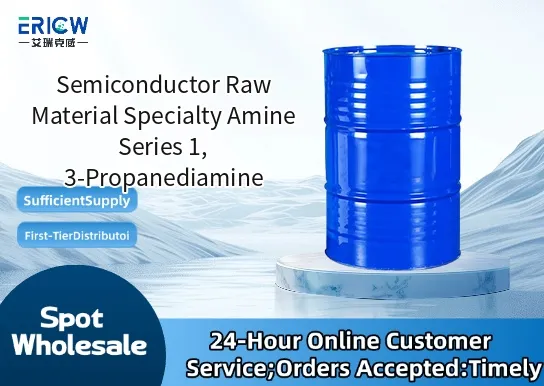
High-purity grade (≥99.5%) specifically engineered for semiconductor-grade chemical synthesis and metal chelation processes.
Controlled low volatility and optimized thermal stability for precise vapor-phase delivery in CVD and ALD precursor formulations.
Consistent batch-to-batch reproducibility with stringent trace metal impurity control (<10 ppb each of Fe, Cu, Ni, Na).
Bifunctional aliphatic diamine structure enabling selective coordination with transition metals and surface passivation on SiO₂/SiNₓ substrates.
Non-hygroscopic solid form at ambient conditions—enhancing handling safety and formulation shelf life under inert atmosphere.
Chelating ligand in high-k dielectric metal-organic precursors (e.g., Hf, Zr, Al amides) for atomic layer deposition (ALD).
Surface modifier for functionalizing silica-based CMP slurries to improve particle dispersion and reduce defectivity.
Building block in photoresist additive chemistry for enhancing adhesion promotion and lithographic resolution control.
Stabilizer in copper electroplating bath formulations to suppress dendritic growth and improve via-fill uniformity.
Reactive intermediate in the synthesis of semiconductor-grade polyimide precursors for flexible interlayer dielectrics.
| Chemical Type | Aliphatic diamine |
| Product Form | White crystalline solid (re-crystallized, vacuum-dried) |
| Appearance | Free-flowing, odorless crystals; no visible particulates or discoloration |
| Melting Point | 28–30 °C (certified by DSC, ±0.5 °C tolerance) |
| Primary Applications | ALD/CVD precursor ligand, CMP additive, photoresist enhancer, electroplating stabilizer |
| Key Features | Bifunctional chelation, low residual moisture (<50 ppm), ultra-low halide content (<1 ppm Cl⁻) |
| Benefits | Enables sub-5nm process compatibility, reduces metallic contamination, improves film conformality |
| Regulatory Compliance | REACH registered; RoHS 2.0 compliant; ISO 9001 & ISO 14001 certified manufacturing |
| Common Compatible Systems | Suitability |
| Hf(OtBu)₂(dmae)₂ / 1,3-Propanediamine co-ligand system | Highly Recommended – Enables stable, low-volatility Hf precursor with improved ALD growth rate linearity |
| CMP slurry containing colloidal silica (e.g., Cab-O-Sil® TS-720) | Recommended – Enhances zeta potential stability without agglomeration up to pH 10.5 |
| Acid-catalyzed positive-tone photoresist matrix (e.g., novolac-DNQ) | Suitable – Improves substrate adhesion without compromising dissolution contrast |
| Acid copper electroplating bath (SPS/Cl⁻/PEG system) | Recommended – Reduces copper nodulation and improves bottom-up fill in 10:1 aspect ratio vias |
Q1: What is the CAS Registry Number for this specialty-grade 1,3-propanediamine?
A: The CAS number is 109-55-7. This product is manufactured and purified to semiconductor-grade specifications, distinct from technical-grade material bearing the same CAS.
Q2: What is the recommended dosage range when used as a ligand in Hf-based ALD precursors?
A: Typical molar ratio is 1.8–2.2 equivalents per Hf center. Optimal performance is observed at 2.0 equivalents with strict stoichiometric control under <1 ppm O₂/H₂O inert environment.
Q3: How does this specialty amine differ from standard 1,3-propanediamine in terms of extractable impurities?
A: Unlike commercial grades, this variant undergoes multi-stage sublimation and argon-purged crystallization, reducing extractable alkali metals (Na⁺, K⁺) to <5 ppb and eliminating detectable sulfate, phosphate, and nitrate residues by IC-MS.
Q4: Is migration into silicon wafers observed during thermal processing, and what is the validated upper temperature limit?
A: No measurable migration occurs below 220 °C per TOF-SIMS depth profiling. Decomposition onset is 245 °C (TGA, 10 °C/min, N₂); recommended max process temperature is 215 °C for sustained use.
Q5: Does this material comply with SEMI S2/S8 safety and environmental standards for fab use?
A: Yes—fully compliant with SEMI S2-0220 (health & safety) and SEMI S8-0720 (environmental impact). Full EHS dossier, including LC₅₀ (rat inhalation), skin sensitization data, and waste treatment guidance, is available under NDA.
Contact With Us:
E-mail: wangxingqiang@ericwchem.com
Have a Questions? Call Us:
Add:
Building A1, Jiete Industrial Park, Huangpu District, Guangzhou City, Guangdong Province, China