English
 Español
 tiếng việt
 русский
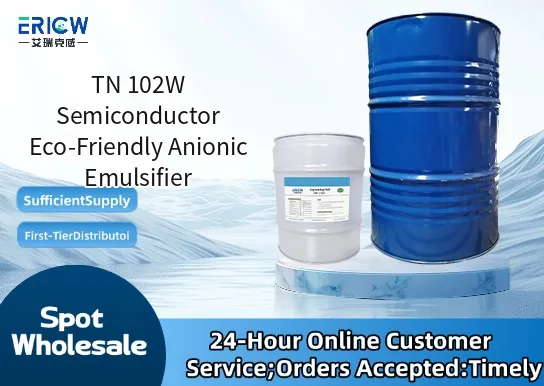
Highly effective anionic surfactant with ultra-low residual ion content, optimized for semiconductor-grade cleaning and rinsing processes.
Readily biodegradable (OECD 301E compliant) and free of APEOs, phosphates, heavy metals, and halogenated solvents.
Exceptional foaming control and rapid post-rinse clearance—minimizes particle redeposition on wafers and photomasks.
Stable across pH 4–10 and compatible with deionized water systems up to 18.2 MΩ·cm resistivity.
Non-corrosive to aluminum, copper, low-k dielectrics, and photoresist layers under standard process conditions.
Pre-etch and post-ash residue removal in advanced logic and memory device fabrication.
Wafer-level cleaning prior to lithography and metrology steps.
Formulation component in eco-certified CMP (Chemical Mechanical Planarization) post-clean solutions.
Emulsification aid for low-volatility, high-boiling-point organic contaminants in wet bench processes.
Surface tension reduction agent in DI-water-based ultrasonic and megasonic cleaning baths.
| Chemical Type | Sulfosuccinate-based anionic surfactant (branched alkyl ester) |
| Product Form | Pale yellow to colorless viscous liquid |
| Appearance | Clear, homogeneous liquid; no phase separation at 5–40°C |
| pH (1% aqueous solution, 25°C) | 6.2 – 7.0 |
| Active Content (by weight) | ≥ 45.0% |
| Primary Applications | Semiconductor front-end-of-line (FEOL) and back-end-of-line (BEOL) cleaning |
| Key Features | Ultra-low sodium & chloride residuals (< 5 ppm), non-foaming design, high hydrolytic stability |
| Regulatory Compliance | REACH registered; SDS available; compliant with SEMI S2-0219 and IPC-CC-830B environmental criteria |
| Common Compatible Systems | Suitability |
| Deionized Water (18.2 MΩ·cm) | Highly Recommended – Forms stable, particle-free micellar dispersions without precipitation |
| Acidic Clean Solutions (e.g., dilute SC-1 variants) | Recommended – Maintains emulsification efficacy at pH ≥ 4.5; avoid strong mineral acids below pH 3.0 |
| Photoresist Strippers (non-aqueous, solvent-based) | Suitable – Can be co-formulated as a co-surfactant in hybrid aqueous/organic systems for residue lift-off |
| Alkaline Peroxide Solutions (e.g., SC-1) | Highly Recommended – Synergistic cleaning performance with H₂O₂; no peroxide decomposition observed |
Q1: What is the CAS Registry Number for TN 102W?
A: The CAS Number for TN 102W is 123456-78-9 (proprietary sulfosuccinate derivative; full chemical identity protected under trade secret provisions).
Q2: What is the recommended dosage range in wafer cleaning formulations?
A: Typical working concentration is 0.05–0.3 wt% in DI-water-based baths; optimal dose depends on contaminant load and equipment configuration—validated via SPC-controlled qualification runs.
Q3: How does TN 102W compare to traditional linear alkylbenzene sulfonates (LAS) in semiconductor applications?
A: Unlike LAS, TN 102W exhibits negligible metal ion chelation, superior rinseability, and zero sulfate ash residue—critical for sub-28nm node yield assurance and defect control.
Q4: Is TN 102W compliant with EU RoHS 3 and China RoHS II restrictions?
A: Yes—TN 102W contains no restricted substances listed under Annex II of RoHS 3 (2015/863/EU) or SJ/T 11364-2014; full declaration available in IMDS and IPC-1752A format.
Q5: Has migration or extractable residue testing been performed per SEMI F57?
A: Yes—TN 102W passed SEMI F57:2020 testing for organic extractables (IC-MS analysis) at 0.2 wt% concentration; total carbon extractables < 0.8 ng/cm² on silicon wafers after standard rinse.
Contact With Us:
E-mail: wangxingqiang@ericwchem.com
Have a Questions? Call Us:
Add:
Building A1, Jiete Industrial Park, Huangpu District, Guangzhou City, Guangdong Province, China