English
 Español
 tiếng việt
 русский
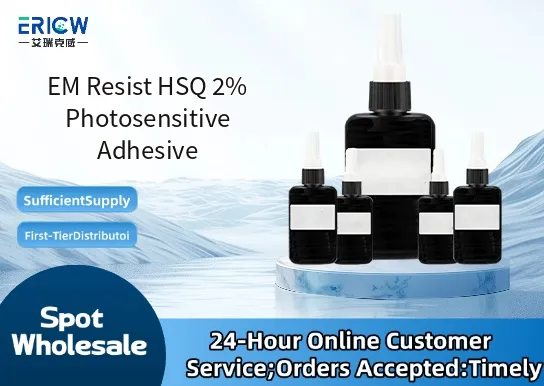
High-resolution negative-tone patterning capability with sub-10 nm feature definition under e-beam lithography.
Ultra-thin silicon-rich quartz (HSQ) matrix enabling exceptional etch resistance and thermal stability up to 1000 °C in inert atmospheres.
Low-viscosity 2% solids solution in high-purity methyl isobutyl ketone (MIBK), optimized for uniform spin-coating on Si, SiO₂, and metal substrates.
No post-application baking required — direct UV or e-beam exposure followed by aqueous-based development.
Minimal outgassing and low metal ion contamination (<1 ppb Na/K/Ca), meeting stringent requirements for semiconductor and MEMS fabrication.
Nanoscale electron-beam lithography for quantum device fabrication and nanowire templates.
Hard mask layer in advanced CMOS and FinFET process integration requiring high-temperature annealing compatibility.
Patterned etch mask for deep reactive ion etching (DRIE) of silicon and silicon carbide substrates.
Direct-write lithography in research laboratories for photonic crystal, plasmonic, and metamaterial nanostructures.
Multi-layer resist stacks where HSQ serves as a bottom anti-reflective coating (BARC) and etch hardmask simultaneously.
| Chemical Type | Silicon-based inorganic polymer (Hydrogen Silsesquioxane) |
| Product Form | Clear, colorless liquid solution |
| Appearance | Homogeneous, particle-free, low-haze solution |
| Solvent System | Methyl isobutyl ketone (MIBK), ultra-high purity (≥99.99%) |
| Solids Content | 2.0 ± 0.1 wt% HSQ |
| Viscosity (25 °C) | 1.8–2.2 cP |
| Primary Applications | E-beam lithography, UV nanoimprint master fabrication, high-resolution hardmasking |
| Regulatory Compliance | REACH compliant; RoHS 3 (2015/863/EU) compliant; no SVHCs above threshold |
| Common Compatible Systems | Suitability |
| JEOL JSM & JEM series e-beam writers (e.g., JSM-7900F, JEM-ARM200F) | Highly Recommended – Optimized exposure dose range: 100–500 μC/cm² at 100 keV |
| Canon FPA-1200NZ2C & Nikon NSR-S630D steppers (with 248 nm KrF source) | Recommended – Requires thin film optimization and soft-bake adjustment for UV sensitivity |
| EVG® 620 & 720 mask aligners (i-line, g-line) | Suitable – Moderate resolution (~1 μm); best used with high-contrast masks and proximity printing |
| Spin coaters (Laurell WS-650, Headway EC301, etc.) | Highly Recommended – Standard parameters: 3000–5000 rpm, 30 s, ambient air environment |
Q1: What is the CAS Number for EM Resist HSQ 2% Photosensitive Adhesive?
A: The base HSQ polymer component has CAS No. 33240-79-4; the full formulated product (HSQ 2% in MIBK) is assigned proprietary batch-specific registration and is supplied with full SDS per REACH Annex II requirements.
Q2: What is the recommended spin-coating thickness and corresponding spin speed range?
A: At 4000 rpm for 30 seconds, typical dry-film thickness is 25–35 nm; thickness scales approximately with √(1/rpm), allowing precise tuning from 15 nm (6000 rpm) to 60 nm (2000 rpm) on standard Si wafers.
Q3: How does EM Resist HSQ compare to traditional PMMA resists in terms of etch selectivity and thermal stability?
A: HSQ exhibits >10× higher etch resistance versus SiO₂ and Si in CF₄/O₂ plasma compared to PMMA, and remains structurally intact after 1-hour annealing at 900 °C in N₂ — whereas PMMA fully decomposes above 300 °C.
Q4: Are there any known extractables or leachables when HSQ films contact deionized water or common buffer solutions?
A: Fully cured HSQ films show negligible migration (<0.1 ng/cm²) in DI water, PBS (pH 7.4), or 0.1 M HCl after 24 h immersion at 25 °C, as verified by ICP-MS analysis — suitable for microfluidic and bio-MEMS applications.
Contact With Us:
E-mail: wangxingqiang@ericwchem.com
Have a Questions? Call Us:
Add:
Building A1, Jiete Industrial Park, Huangpu District, Guangzhou City, Guangdong Province, China