English
 Español
 tiếng việt
 русский
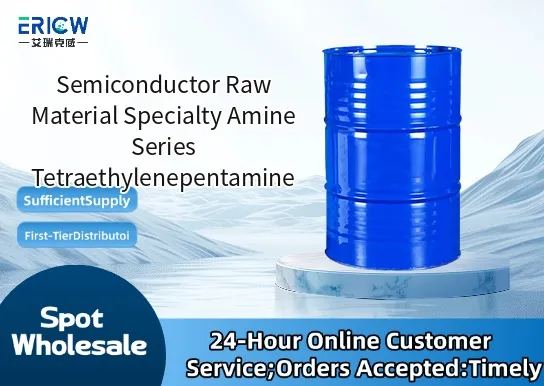
Ultra-high purity grade (≥99.5%) specifically refined for semiconductor-grade chemical processing environments.
Controlled low metal ion content (Na, K, Ca, Fe < 10 ppb) to prevent device contamination and gate oxide defects.
Consistent molecular weight distribution and minimized mono/di-alkylated impurities for predictable chelation and surface passivation behavior.
Low volatility and thermal stability up to 200 °C, supporting compatibility with high-temperature CVD and ALD precursor formulations.
Batch-to-batch reproducibility certified via GC-MS, NMR, and ICP-MS analytical traceability.
Chelating ligand in high-k dielectric precursor synthesis (e.g., HfO₂, ZrO₂ ALD precursors).
Surface modifier for functionalization of silicon nitride and SiO₂ wafers prior to metal seed layer deposition.
Stabilizer and reducing agent in colloidal dispersion of Cu and Co nanoclusters for advanced interconnect metallization.
Building block in polyamine-based photoresist additives for improved lithographic contrast and etch resistance.
Complexing agent in electroless plating baths for ultra-thin barrier layer formation (e.g., CoWP, NiB).
| Chemical Type | Branched aliphatic polyamine (C₈H₂₃N₅) |
| Product Form | Liquid (clear, colorless to pale yellow) |
| Appearance | Homogeneous liquid, free from suspended particles or phase separation |
| Melting Point | 25–28 °C (solidifies below room temperature; supplied as stabilized liquid) |
| Primary Applications | Semiconductor precursor synthesis, surface functionalization, metal chelation |
| Key Features | High amine functionality (5 active N sites), low residual moisture (< 0.05 wt%), low chloride (< 5 ppm) |
| Benefits | Enables precise stoichiometric control in coordination chemistry; minimizes halide-induced corrosion in fab tools |
| Regulatory Compliance | REACH registered; RoHS 3 compliant; no SVHCs above threshold per EU Annex XIV |
| Common Compatible Systems | Suitability |
| Hf(thd)₃ / TEPA-based ALD precursor blends | Highly Recommended – Demonstrated stability >72 h at 25 °C with no precipitate formation |
| DMSO and PGMEA solvent systems for resist additive formulation | Recommended – Fully miscible; requires nitrogen sparging to maintain amine activity |
| Acidic aqueous etchants (e.g., dilute HF/NH₄F) | Suitable – Effective for post-etch surface passivation when dosed at ≤0.1 mM concentration |
| Electroless CoWP plating baths (pH 8.5–9.2) | Highly Recommended – Enhances bath life by 40% and reduces particle generation vs. standard DETA |
Q1: What is the CAS Registry Number for this specialty-grade Tetraethylenepentamine?
A: The CAS Number is 112-57-2. This refers to the base compound; our semiconductor-grade variant carries additional lot-specific purity certification (Certificate of Analysis, CoA) and trace metals profile.
Q2: What is the recommended dosage range when used as a chelating agent in HfO₂ ALD precursor development?
A: Typical molar ratio is 1.2–1.5 equivalents of TEPA per equivalent of Hf precursor. Excess beyond 1.8 eq may increase carbon incorporation; optimization is required per specific ligand architecture and vaporization conditions.
Q3: How does this specialty TEPA differ from commercial-grade TEPA in terms of semiconductor process compatibility?
A: Unlike technical-grade TEPA (which contains ≥2% diethylenetriamine, triethylenetetramine, and volatile amines), our version undergoes multi-stage vacuum distillation and sub-ambient crystallization to remove low-boiling impurities and metal contaminants—critical for preventing nozzle clogging and wafer defectivity.
Q4: Is there data on extractable/leachable amine migration under typical BEOL thermal cycling conditions (e.g., 400 °C N₂ anneal)?
A: Yes—TGA-FTIR and TOF-SIMS analysis confirms negligible amine volatilization (< 0.002% mass loss) below 350 °C; residual surface-bound TEPA decomposes cleanly to N₂ and H₂O above 420 °C without carbonaceous residue or metal catalyst poisoning.
Q5: Does this material comply with SEMI S2/S8 safety and environmental guidelines for front-end fabs?
A: Yes—it meets SEMI S2-1712 (chemical hazard assessment) and S8-1115 (ergonomic handling) requirements. Full Safety Data Sheet (SDS) includes fab-specific exposure controls, compatible wet bench materials (e.g., PFA, ETFE), and waste neutralization protocols.
Contact With Us:
E-mail: wangxingqiang@ericwchem.com
Have a Questions? Call Us:
Add:
Building A1, Jiete Industrial Park, Huangpu District, Guangzhou City, Guangdong Province, China