English
 Español
 tiếng việt
 русский
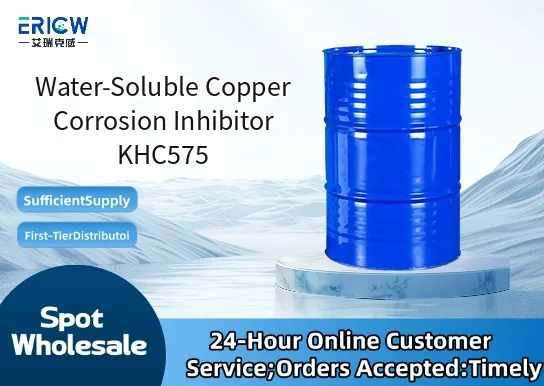
Highly effective in forming a stable, self-assembled protective film on copper and copper alloy surfaces.
Exceptional water solubility (>500 g/L at 25°C), enabling rapid dispersion and uniform treatment in aqueous systems.
Non-toxic, amine-free formulation with low volatility and no nitrite or heavy metal content.
Thermally stable up to 180°C, maintaining inhibition performance under elevated operating temperatures.
pH-compatible across broad range (pH 5.5–9.5), supporting use in neutral and mildly alkaline cooling and process waters.
Closed-loop chilled water systems containing copper tubing, heat exchangers, and finned coils.
Industrial cooling towers with mixed-metal circuits (copper, steel, aluminum, stainless steel).
Heat transfer fluids for HVAC and data center liquid cooling infrastructure.
Process water systems in semiconductor manufacturing tool cooling loops.
Pharmaceutical clean steam condensate return lines where copper corrosion control is critical.
| Chemical Type | Heterocyclic triazole derivative (benzotriazole analog) |
| Product Form | Free-flowing white to off-white crystalline powder |
| Appearance | Crystalline solid, odorless |
| Melting Point | 102–105°C |
| Solubility in Water (25°C) | >500 g/L |
| pH of 1% Aqueous Solution | 6.2–6.8 |
| Primary Applications | Copper corrosion inhibition in recirculating aqueous systems |
| Regulatory Compliance | REACH registered; compliant with US EPA Safer Choice Criteria (Section 2); non-listed under TSCA Inventory (pre-manufacture notification completed) |
| Common Compatible Systems | Suitability |
| Alkaline Cooling Water (pH 7.5–9.0, with phosphonate/polymer blends) | Highly Recommended – Synergistic with common scale inhibitors; no precipitation observed |
| Ferrous Metal Systems (carbon steel, cast iron) | Recommended – Provides moderate protection; best used with supplemental ferrous inhibitors |
| Stainless Steel 304/316 Circuits | Suitable – Non-aggressive; no chloride-induced stress corrosion cracking risk |
| Glycol-Based Heat Transfer Fluids (up to 50% propylene glycol) | Highly Recommended – Fully miscible; maintains film integrity in low-water-activity environments |
Q1: What is the CAS Registry Number for KHC575?
A: The CAS Number for KHC575 is 155679-57-7.
Q2: What is the recommended dosage range in closed-loop systems?
A: Typical dosage is 20–100 ppm (as active) depending on system metallurgy, temperature, and water quality; initial charge at 50–100 ppm followed by maintenance dosing at 20–40 ppm is standard practice.
Q3: How does KHC575 compare to traditional benzotriazole (BTA) in performance and safety?
A: KHC575 offers superior solubility and faster surface adsorption vs. BTA, eliminates handling concerns associated with BTA’s poor water solubility and potential skin sensitization, and demonstrates lower aquatic toxicity (EC50 > 100 mg/L, Daphnia magna).
Q4: Is KHC575 subject to migration or leaching in potable water contact applications?
A: When applied per specifications in non-potable industrial systems, KHC575 forms a tightly bound monolayer with negligible leaching; it is not approved for direct potable water use and has not undergone NSF/ANSI 61 certification.
Contact With Us:
E-mail: wangxingqiang@ericwchem.com
Have a Questions? Call Us:
Add:
Building A1, Jiete Industrial Park, Huangpu District, Guangzhou City, Guangdong Province, China