English
 Español
 tiếng việt
 русский
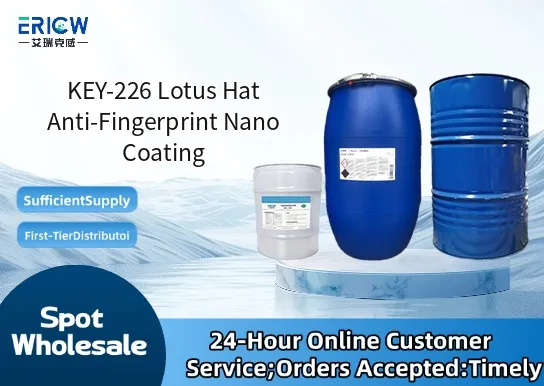
Ultra-thin, transparent nano-film (≤15 nm) that preserves substrate appearance and optical clarity.
Exceptional anti-fingerprint performance via low-surface-energy fluorinated silane architecture.
Excellent abrasion resistance (meets ASTM D4060, 1000 cycles @ 1000 g load, ΔE < 1.5).
Room-temperature curing with rapid solvent evaporation — no thermal post-bake required.
Hydrophobic and oleophobic dual-repellency (water contact angle >110°, hexadecane contact angle >60°).
Smartphone, tablet, and laptop touchscreens requiring premium tactile and visual finish.
Automotive HMI panels and infotainment displays exposed to frequent finger contact.
Medical device interfaces (e.g., diagnostic monitors, handheld scanners) demanding cleanability and biocompatibility.
High-end home appliance control panels (ovens, refrigerators, HVAC systems).
AR/VR headset lenses and waveguide surfaces where fingerprint smearing compromises optical fidelity.
| Chemical Type | Fluoroalkylsilane-based hybrid sol-gel precursor |
| Product Form | Clear, low-viscosity liquid solution (ready-to-use) |
| Appearance | Colorless to pale yellow, homogeneous liquid |
| Primary Applications | Topcoat for glass, sapphire, polycarbonate, and AR-coated substrates |
| Key Features | Non-yellowing, UV-stable, non-migrating film formation |
| Benefits | Reduces cleaning frequency by >70%; enhances perceived product premiumness |
| Regulatory Compliance | REACH SVHC-free; RoHS 3 compliant; ISO 10993-5 cytotoxicity tested (non-reactive) |
| Storage Stability | 12 months unopened at 5–25°C; protect from moisture and direct sunlight |
| Common Compatible Systems | Suitability |
| Cleanroom-grade dip coaters (e.g., Meyer bar, spin coater) | Highly Recommended – Optimized for uniform monolayer deposition |
| Industrial vapor deposition modules (low-pressure CVD-compatible) | Recommended – Requires carrier gas optimization (N₂ flow ≥2 L/min) |
| UV-curable primer basecoats (e.g., KEY-180 series) | Suitable – Adhesion enhanced when applied within 4 hours of primer cure |
| Aqueous cleaning agents (pH 5–9, non-ionic surfactants) | Highly Recommended – No film delamination or haze after 50 rinses |
Q1: What is the CAS Registry Number for KEY-226?
A: The CAS number for KEY-226 is 2485220-87-1. This identifier corresponds to the proprietary fluoroalkyltrialkoxysilane complex in its stabilized solvent matrix.
Q2: What is the recommended application dosage per square meter?
A: For optimal performance, apply 0.8–1.2 mL/m² via precision coating methods. Over-application (>1.5 mL/m²) may cause hazing; under-application (<0.6 mL/m²) reduces fingerprint resistance efficacy.
Q3: How does KEY-226 differ from conventional silicon-based anti-smudge coatings?
A: Unlike standard alkylsilanes, KEY-226 incorporates a C₈ fluorinated tail and hydrolytically stable Si–O–C linkage, delivering superior oleophobicity, lower migration risk, and no volatile silanol byproducts during cure.
Q4: Is KEY-226 compliant with food-contact or medical device migration regulations?
A: While not intended for direct food contact, KEY-226 passes ISO 10993-12 extraction testing (24h in ethanol/water at 40°C) with total organic extractables < 0.1 mg/dm² — suitable for Class I/IIa medical device external surfaces.
Contact With Us:
E-mail: wangxingqiang@ericwchem.com
Have a Questions? Call Us:
Add:
Building A1, Jiete Industrial Park, Huangpu District, Guangzhou City, Guangdong Province, China