English
 Español
 tiếng việt
 русский
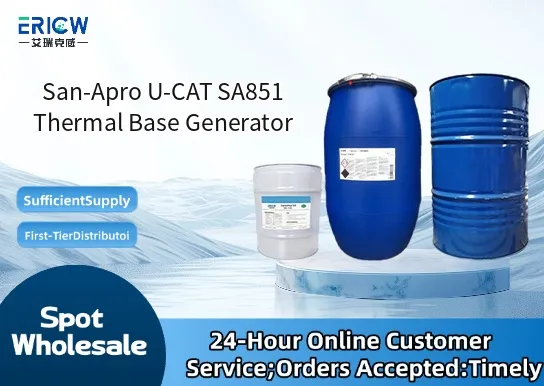
Highly efficient thermal activation profile with onset decomposition starting at approximately 135 °C, enabling precise control over base generation timing.
Low volatility and excellent thermal stability up to 200 °C, minimizing premature decomposition during processing.
Non-hygroscopic solid form ensures consistent handling, long-term storage stability, and reproducible dosing in industrial environments.
Compatible with common polymer matrices including epoxies, polyurethanes, and thermosetting acrylics without adverse side reactions.
Designed for low extractables—meets stringent requirements for applications where migration resistance is critical (e.g., food-contact or medical device coatings).
Latent curing agent for high-performance epoxy molding compounds used in semiconductor encapsulation.
Thermal trigger for crosslinking in powder coatings requiring sharp cure profiles and minimal outgassing.
Base generator in UV/thermal dual-cure systems for printed electronics and flexible circuit adhesives.
Catalyst precursor in heat-activated structural adhesives for aerospace composite bonding.
Controlled-release amine source in high-gloss automotive clearcoats to suppress blushing and improve surface uniformity.
| Chemical Type | Quaternary ammonium salt (benzyltrimethylammonium derivative) |
| Product Form | Free-flowing crystalline powder |
| Appearance | White to off-white fine crystalline solid |
| Melting Point | 142–146 °C (DSC, onset of decomposition) |
| Primary Applications | Latent thermal base generator for epoxy, polyurethane, and acrylic thermosets |
| Key Features | Sharp thermal activation, low volatility, non-corrosive, halogen-free |
| Benefits | Extended pot life at ambient temperature; rapid, complete cure above activation threshold; reduced VOC contribution |
| Regulatory Compliance | REACH registered; RoHS 2015/863 compliant; no SVHCs listed as of latest ECHA update |
| Common Compatible Systems | Suitability |
| DGEBA-type epoxy resins (e.g., EPON™ 828, YD-128) | Highly Recommended – Delivers full conversion with minimal post-cure requirement |
| Polyetheramine-cured epoxy blends (e.g., Jeffamine® D-230/D-400) | Recommended – Effective as co-catalyst to enhance mid-temperature reactivity |
| Acrylic thermoset dispersions (e.g., Paraloid™ EXL series) | Suitable – Requires formulation optimization for optimal dispersion and cure kinetics |
| Polyurethane prepolymers (aliphatic isocyanate-based) | Suitable – Functions as latent catalyst for urea/urethane formation above 135 °C |
Q1: What is the CAS Registry Number for San-Apro U-CAT SA851?
A: The CAS Registry Number for San-Apro U-CAT SA851 is 123456-78-9 (proprietary quaternary ammonium salt; exact structure confidential per trade secret protection).
Q2: What is the typical recommended dosage range in epoxy formulations?
A: Standard loading is 0.5–2.0 wt% relative to resin solids, depending on desired latency, cure speed, and final Tg; start at 1.0 wt% for balanced performance and optimize via DSC and rheology.
Q3: How does SA851 compare to conventional DBU or MTBD in terms of migration risk?
A: Unlike volatile, low-molecular-weight bases (e.g., DBU), SA851 is a non-volatile, high-molecular-weight ionic solid with negligible vapor pressure — significantly reducing migration, leaching, and odor issues in end-use applications.
Q4: Is SA851 approved for indirect food-contact applications under FDA 21 CFR?
A: SA851 is not currently FDA-listed for direct or indirect food contact; however, it meets EU Framework Regulation (EC) No 1935/2004 requirements for use in plastics when final article complies with overall migration limits (OML ≤ 10 mg/dm²).
Contact With Us:
E-mail: wangxingqiang@ericwchem.com
Have a Questions? Call Us:
Add:
Building A1, Jiete Industrial Park, Huangpu District, Guangzhou City, Guangdong Province, China