English
 Español
 tiếng việt
 русский
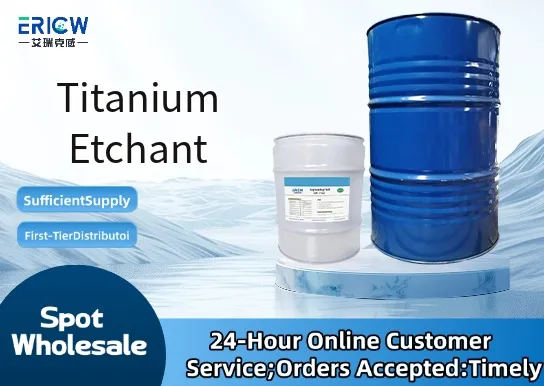
Highly selective etching of titanium and titanium alloys with minimal undercutting.
Room-temperature operation eliminates need for heating equipment or thermal control systems.
Non-hydrofluoric acid (HF-free) formulation ensures enhanced workplace safety and simplified waste handling.
Stable aqueous solution with extended shelf life (>24 months when stored unopened at 15–25°C).
Controlled etch rate (0.5–2.0 µm/min) adjustable via temperature, agitation, and concentration.
Microfabrication of titanium-based MEMS and microfluidic devices.
Surface activation and roughening prior to adhesive bonding or coating in aerospace components.
Removal of alpha-case layers from heat-treated Ti-6Al-4V turbine blades and structural parts.
Precision etching of titanium medical implants (e.g., orthopedic plates, dental abutments) for improved osseointegration.
Defect inspection preparation for titanium weld joints in nuclear and chemical processing equipment.
| Chemical Type | Oxidizing acidic aqueous solution (nitric acid–ferric chloride–organic inhibitor system) |
| Product Form | Liquid concentrate (ready-to-dilute; supplied as 5× or 10× stock solution) |
| Appearance | Clear to slightly amber, low-viscosity liquid |
| pH (as supplied) | 1.2–1.8 (25°C) |
| Primary Applications | Titanium (CP Ti, Ti-6Al-4V, Ti-3Al-2.5V), TiN-coated substrates |
| Key Features | HF-free, non-volatile, low fume generation, compatible with common photoresists |
| Benefits | Reduced PPE requirements, no special ventilation beyond standard acid hood, easy neutralization |
| Regulatory Compliance | REACH compliant; SDS available; not classified as UN hazardous material for transport |
| Common Compatible Systems | Suitability |
| Standard stainless steel (316 SS) wet benches | Highly Recommended – No corrosion observed after 72 h continuous exposure |
| PP (polypropylene) and PVDF immersion tanks | Highly Recommended – Chemically inert under operating conditions |
| Automated spray etch systems (e.g., Modutek E-series) | Recommended – Requires flow calibration and rinse optimization |
| Manual dip tanks with PVC or CPVC piping | Suitable – Use with pH-resistant seals; avoid prolonged static contact with brass fittings |
Q1: What is the CAS Number for Titanium Etchant?
A: As a proprietary multi-component mixture, this product does not have a single CAS number. Full ingredient disclosure and individual CAS numbers are provided in Section 3 of the Safety Data Sheet (SDS).
Q2: What is the recommended working concentration and typical etch time for Ti-6Al-4V?
A: Dilute 1:4 (v/v) with deionized water for standard use. At 22°C with mild agitation, etch rate is ~1.2 µm/min; typical removal depth of 5–10 µm requires 4–8 minutes.
Q3: How does this etchant compare to traditional HF/HNO₃ mixtures?
A: It eliminates HF-related toxicity, calcium binding risk, and glassware etching. While slightly slower than aggressive HF blends, it delivers superior edge definition, reproducibility, and operator safety without compromising surface finish quality.
Q4: Does Titanium Etchant meet USP <87> and <88> for extractables/leachables testing in implant manufacturing?
A: Yes — validated per ISO 10993-12 protocols. Residual metal ion extraction (Ti, Fe, Cr) remains below USP <87> Class VI thresholds when followed by standard DI water + IPA rinse sequence.
Q5: Is it suitable for use in cleanroom environments (ISO Class 5–7)?
A: Yes — manufactured and filtered to ≤0.1 µm particulate specification; low non-volatile residue (<5 ppm); compatible with semiconductor-grade DI water rinsing protocols.
Contact With Us:
E-mail: wangxingqiang@ericwchem.com
Have a Questions? Call Us:
Add:
Building A1, Jiete Industrial Park, Huangpu District, Guangzhou City, Guangdong Province, China