English
 Español
 tiếng việt
 русский
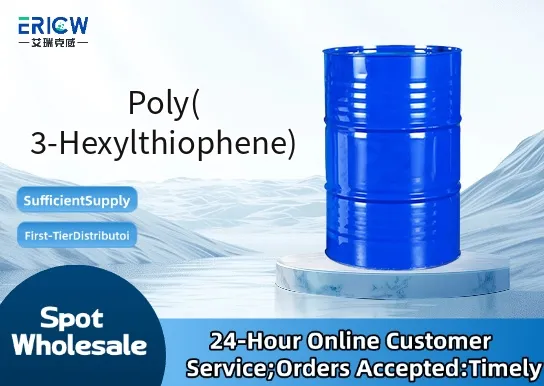
High charge carrier mobility enabling efficient organic electronic device performance.
Excellent solution processability in common organic solvents (e.g., chloroform, toluene, chlorobenzene).
Tunable optoelectronic properties via controlled molecular weight and regioregularity.
Enhanced thermal and oxidative stability compared to unsubstituted polythiophene derivatives.
Well-established synthesis and purification protocols ensuring batch-to-batch reproducibility.
Active layer in solution-processed organic field-effect transistors (OFETs).
Donor material in bulk heterojunction organic photovoltaic (OPV) cells.
Conductive component in flexible and printed electronics inks.
Charge transport layer in perovskite solar cells and OLED devices.
Functional coating for electrochemical sensors and biosensors.
| Chemical Type | Regioregular semicrystalline conjugated polymer |
| Product Form | Powder or solid film (solvent-cast) |
| Appearance | Dark purple to black free-flowing powder |
| Molecular Weight (Mn) | 20–60 kDa (typical range; reported as GPC vs. polystyrene standards) |
| Regioregularity | ≥94% head-to-tail coupling (determined by 1H NMR) |
| Primary Applications | Organic electronics: OFETs, OPVs, sensors |
| Key Features | Solution-processable, air-stable (inert atmosphere recommended for long-term storage) |
| Regulatory Compliance | REACH compliant; no SVHCs listed under current ECHA candidate list |
| Common Compatible Systems | Suitability |
| Chloroform / Chlorobenzene solvent systems | Highly Recommended – Optimal solubility and film-forming characteristics |
| PCBM ([6,6]-Phenyl-C61-butyric acid methyl ester) blends | Highly Recommended – Proven donor–acceptor compatibility in OPV active layers |
| PEDOT:PSS hole transport layer | Recommended – Standard anode interface for P3HT-based devices |
| PMMA and PS polymer matrices | Suitable – Compatible for blend films requiring mechanical reinforcement or phase separation control |
Q1: What is the CAS Number for Poly(3-hexylthiophene)?
A: The CAS Registry Number for Poly(3-hexylthiophene) is 156710-73-5.
Q2: What is the typical recommended concentration for spin-coating P3HT films?
A: For standard OFET or OPV fabrication, concentrations of 5–20 mg/mL in chlorobenzene or chloroform are commonly used, depending on desired film thickness and morphology.
Q3: How does P3HT compare to newer polymers like PBDB-T or PM6 in OPV applications?
A: P3HT offers superior process robustness and lower synthetic complexity but delivers lower power conversion efficiencies (<10%) versus state-of-the-art non-fullerene acceptor systems (>18%). It remains preferred for R&D, teaching labs, and stability benchmarking.
Q4: Is P3HT compliant with food contact or medical device regulations?
A: No — P3HT is not approved for food contact or implantable medical use. It is intended solely for research and industrial electronic materials applications under controlled handling conditions.
Q5: Does P3HT exhibit extractable components under thermal or solvent exposure?
A: Residual catalysts (e.g., Ni(dppp)Cl2) or low-MW oligomers may be present at trace levels; rigorous post-synthesis precipitation and Soxhlet extraction (e.g., with methanol, hexane, and acetone) minimize extractables for high-reliability device fabrication.
Contact With Us:
E-mail: wangxingqiang@ericwchem.com
Have a Questions? Call Us:
Add:
Building A1, Jiete Industrial Park, Huangpu District, Guangzhou City, Guangdong Province, China