English
 Español
 tiếng việt
 русский
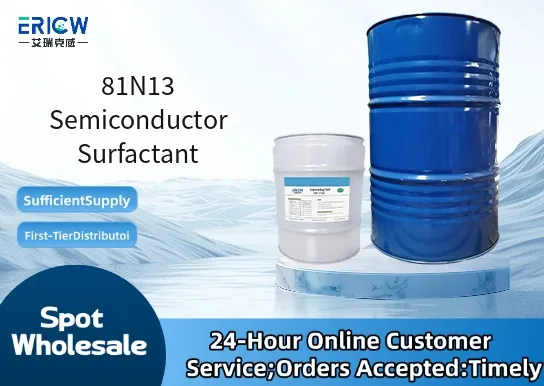
Ultra-low residue formulation designed for high-purity semiconductor cleaning and rinsing processes.
Non-ionic, alcohol-ethoxylate-based structure ensuring excellent compatibility with photoresists and sensitive device layers.
Highly effective at reducing surface tension without introducing metallic ions or halogen contaminants.
Readily biodegradable under OECD 301B standard, supporting sustainable fab environmental programs.
Stable across pH 4–10 and compatible with deionized water (DIW) rinse systems up to 80 °C.
Post-etch and post-CMP wafer rinse additive for particle removal enhancement.
Carrier fluid component in ultra-low concentration megasonic cleaning formulations.
Surface energy modifier in spin-coating pre-wet steps for uniform thin-film deposition.
Residue mitigation agent in advanced packaging cleaning for copper pillar and RDL structures.
Low-VOC alternative to traditional fluorosurfactants in wet bench processing tools.
| Chemical Type | Non-ionic alcohol ethoxylate (C12–C15, avg. EO = 7) |
| Product Form | Ambient-stable clear liquid |
| Appearance | Colorless to pale yellow, transparent, low-viscosity liquid |
| Primary Applications | Wafer surface conditioning, DIW rinse enhancement, particle lift-off aid |
| Key Features | Halogen-free, non-foaming, low TOC contribution (<10 ppm at 0.05% w/w) |
| Benefits | Reduces micro-droplet drying marks; improves contact angle uniformity on Si, SiO₂, and low-k dielectrics |
| Regulatory Compliance | REACH SVHC-free; RoHS 2015/863 compliant; no California Prop 65 listed substances |
| Storage Stability | 24 months unopened at 5–30 °C; no phase separation or crystallization observed |
| Common Compatible Systems | Suitability |
| Standard DIW rinse modules (e.g., Tokyo Electron, SCREEN, Lam Research) | Highly Recommended – Validated for ≤0.1% v/v dosing with no nozzle clogging or sensor interference |
| Ultrapure megasonic tanks (frequency ≥850 kHz) | Highly Recommended – No cavitation inhibition; maintains acoustic efficiency |
| Single-wafer spin-rinse-dry (SRD) platforms | Recommended – Requires precise metering control; validated for 0.02–0.08% w/w range |
| Batch-type wet benches with PFA-lined tanks | Suitable – Compatible with PFA, quartz, and PVDF wetted materials; no leaching observed |
Q1: What is the CAS Registry Number for 81N13?
A: The CAS Number for 81N13 Semiconductor Surfactant is 9002-92-0 (alcohol ethoxylates, C12–C15).
Q2: What is the recommended usage concentration in DIW rinse applications?
A: Optimal performance is achieved at 0.03–0.07% w/w (300–700 ppm) in final rinse DIW; higher concentrations do not improve particle removal and may increase residual organic load.
Q3: How does 81N13 compare to fluorinated surfactants in terms of environmental impact and cleanroom compatibility?
A: Unlike PFAS-based alternatives, 81N13 contains zero perfluoroalkyl substances, eliminates long-term bioaccumulation concerns, and generates no volatile fluorinated byproducts during thermal drying—making it fully compatible with ISO Class 1–3 cleanroom air handling systems.
Q4: Has 81N13 been tested for extractables/migration into process fluids or on-device residues?
A: Yes—tested per SEMI F57 and IEC 60404-8-11 protocols: total organic extractables <5 ng/cm² after 60 s DIW rinse at 25 °C; no detectable migration into photoresist or low-k dielectric layers (LOD: 0.1 ng/cm² via LC-MS/MS).
Contact With Us:
E-mail: wangxingqiang@ericwchem.com
Have a Questions? Call Us:
Add:
Building A1, Jiete Industrial Park, Huangpu District, Guangzhou City, Guangdong Province, China