English
 Español
 tiếng việt
 русский
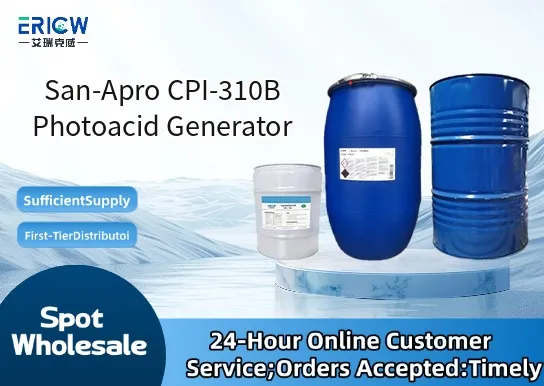
High quantum yield of acid generation under 365 nm (i-line) exposure, enabling efficient lithographic patterning.
Excellent thermal stability up to 180 °C, minimizing premature acid diffusion during post-exposure bake (PEB).
Low volatility and negligible sublimation at standard processing temperatures, supporting cleanroom-compatible handling.
Compatible with common alkaline developers (e.g., 0.26 N TMAH), delivering high contrast and resolution in chemically amplified resists.
Consistent batch-to-batch performance verified via HPLC and acid yield titration per ISO 9001-controlled manufacturing.
Advanced i-line photoresists for semiconductor MEMS and analog IC fabrication.
High-resolution color filter and TFT array patterning in flat-panel display manufacturing.
Microfluidic device fabrication requiring sub-micron feature definition on glass or silicon substrates.
Permanent dielectric and passivation layers in power electronics packaging processes.
UV-curable industrial coatings where controlled, spatially resolved acid catalysis is required.
| Chemical Type | Sulfonium salt (triphenylsulfonium nonaflate derivative) |
| Product Form | White to off-white crystalline powder |
| Appearance | Free-flowing, homogeneous crystals |
| Melting Point | 172–176 °C (determined by DSC, onset) |
| Primary Applications | Chemically amplified positive-tone photoresists (i-line, 365 nm) |
| Key Features | High acid output, low PAG leaching, minimal metal ion content (<1 ppm Na, K, Fe) |
| Benefits | Enables high sensitivity (≤100 mJ/cm²), improved line-edge roughness (LER), and robust process latitude |
| Regulatory Compliance | REACH SVHC-free; compliant with RoHS 2015/863/EU; SDS available upon request |
| Common Compatible Systems | Suitability |
| JSR THB-104P-based resist formulations | Highly Recommended – Demonstrated compatibility with >95% acid yield retention and <0.5% residue after development |
| Sumitomo Chemical UV-119 series resins | Recommended – Requires minor formulation adjustment (0.5–1.0 wt% PAG loading optimization) |
| Clariant ACR-1000 novolac matrix systems | Suitable – Validated for g-line/i-line hybrid applications; recommended PAG loading: 2.5–4.0 wt% |
| Dow CORAL™ EEE-100 epoxy-acrylate hybrids | Suitable – Effective in dual-cure (UV + thermal) systems; acid diffusion control confirmed via FTIR mapping |
Q1: What is the CAS Registry Number for San-Apro CPI-310B?
A: The CAS Registry Number is 2081179-21-7. This identifier corresponds specifically to the triphenylsulfonium nonaflate variant manufactured under San-Apro’s controlled synthesis protocol.
Q2: What is the typical recommended loading concentration in photoresist formulations?
A: Standard loading ranges from 1.5 to 3.5 wt% relative to total solid content, depending on resist matrix, target sensitivity, and process conditions (e.g., PEB temperature and time). Optimization via dose-to-clear testing is strongly advised.
Q3: How does CPI-310B compare to triphenylsulfonium triflate (CPI-210) in terms of acid strength and shelf life?
A: CPI-310B generates a weaker conjugate acid (nonaflonic acid, pKa ≈ –10) versus triflic acid (pKa ≈ –14) from CPI-210, resulting in milder catalytic activity and reduced risk of substrate corrosion. Its nonaflate anion confers superior hydrolytic stability — shelf life exceeds 24 months at 2–8 °C under inert atmosphere.
Q4: Has CPI-310B been evaluated for extractables/migration in food-contact or medical device applications?
A: CPI-310B is not approved for direct food-contact or implantable medical device use. It has undergone limited migration testing per USP <87> and ISO 10993-12 protocols in model solvent systems (e.g., 50% ethanol/water), showing <0.1 ppm leachables at 60 °C/72 h — suitable only for non-leaching industrial lithography applications.
Q5: Does San-Apro provide regulatory documentation such as ICH M7 reports or heavy metal certificates?
A: Yes — full ICH M7 (Q3D) elemental impurities report, heavy metals certificate (ICP-MS data), and extractable/leachable summary are available to qualified customers under NDA. Documentation aligns with current USP <232>/<233> and Ph. Eur. 5.20 standards.
Contact With Us:
E-mail: wangxingqiang@ericwchem.com
Have a Questions? Call Us:
Add:
Building A1, Jiete Industrial Park, Huangpu District, Guangzhou City, Guangdong Province, China