English
 Español
 tiếng việt
 русский
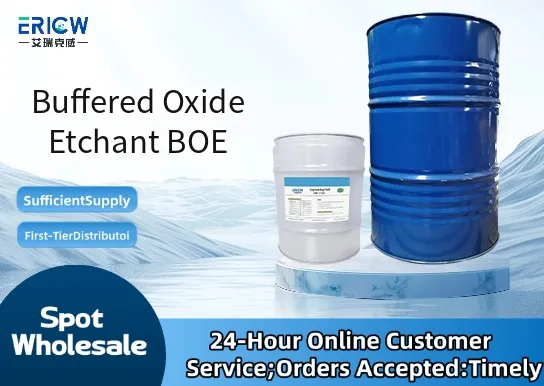
Precisely controlled etch rate for silicon dioxide (SiO₂) due to HF–NH₄F buffering system.
Enhanced process stability and repeatability across wafer batches and extended bath life.
Reduced surface roughness and minimized undercut compared to unbuffered HF solutions.
Low volatility and improved operator safety versus concentrated hydrofluoric acid.
Compatible with standard quartz, Teflon™, and polypropylene wet processing equipment.
Removal of thermal and CVD-grown silicon dioxide in semiconductor front-end-of-line (FEOL) fabrication.
Gate oxide thinning and trimming during MOSFET and CMOS device development.
Release etching in MEMS manufacturing for sacrificial oxide layers.
Surface preparation prior to deposition or bonding in advanced packaging processes.
Mask opening and cleaning steps in photolithography and hard mask patterning workflows.
| Chemical Type | Aqueous buffered hydrofluoric acid solution (HF/NH₄F) |
| Product Form | Liquid concentrate (ready-to-use or dilutable) |
| Appearance | Clear, colorless to pale yellow liquid |
| Primary Applications | Etching of SiO₂, Si₃N₄ (slow), and native oxide removal |
| Key Features | Buffered pH ~4.5–5.0; typical HF:NH₄F molar ratio 1:6 to 1:10 |
| Benefits | Uniform etch profile, low particle generation, high selectivity over silicon and photoresist |
| Regulatory Compliance | REACH registered; SDS available per OSHA/GHS standards |
| Storage Conditions | Store at 15–25°C in corrosion-resistant containers (e.g., HDPE, PTFE-lined) |
| Common Compatible Systems | Suitability |
| Quartz immersion tanks & recirculating wet benches | Highly Recommended – Chemically inert and thermally stable up to 60°C |
| Teflon™ (PTFE/PFA) spray and dip tools | Highly Recommended – No leaching or degradation observed under standard conditions |
| Automated single-wafer spin-rinse-dry (SRD) platforms | Recommended – Requires precise flow control and post-etch rinse optimization |
| Polypropylene chemical delivery manifolds | Suitable – For short-term exposure; avoid prolonged contact above 40°C |
Q1: What is the CAS Registry Number for Buffered Oxide Etchant BOE?
A: BOE is a formulated mixture; individual components have CAS numbers — Hydrofluoric acid (7664-39-3), Ammonium fluoride (12125-01-8). The final product does not carry a single CAS number per regulatory convention.
Q2: How much BOE is typically consumed per 200-mm wafer during standard oxide etch?
A: Consumption varies by process, but typical usage ranges from 15–30 mL per wafer in batch immersion systems; automated tools may use 5–12 mL/wafer depending on dwell time and concentration.
Q3: How does BOE compare to dilute HF (e.g., 0.5% HF) in terms of etch rate control and safety?
A: BOE offers significantly lower free HF concentration and higher buffering capacity, resulting in slower, more predictable etch rates and reduced vapor pressure — improving both process control and workplace safety relative to dilute HF.
Q4: Are there extractables or leachables concerns when using BOE in high-purity applications?
A: High-purity grades meet SEMI C1/C7 specifications; validated low metal content (<10 ppt for Na, K, Fe, Al) and minimal fluorosilicate formation reduce risk of contamination in critical nodes.
Contact With Us:
E-mail: wangxingqiang@ericwchem.com
Have a Questions? Call Us:
Add:
Building A1, Jiete Industrial Park, Huangpu District, Guangzhou City, Guangdong Province, China