English
 Español
 tiếng việt
 русский
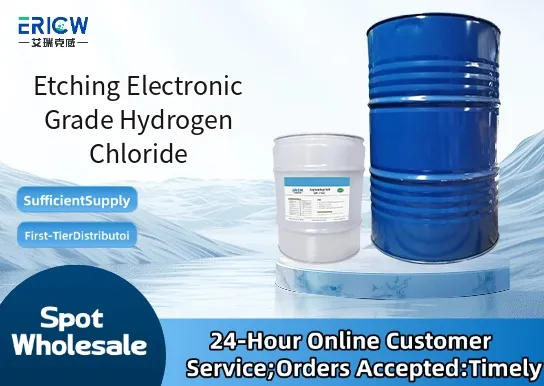
Ultra-high purity (≥99.999% purity, 5N grade) with sub-part-per-trillion metallic impurity control.
Strictly controlled moisture content (<0.1 ppm H₂O) to prevent oxide formation during etching processes.
Consistent vapor-phase delivery performance optimized for precision semiconductor plasma etch tools.
Low non-volatile residue (NVR <10 ng/g) ensuring minimal chamber contamination and extended tool uptime.
Manufactured and packaged under ISO Class 4 cleanroom conditions with electropolished stainless-steel (316L EP) cylinder systems.
Plasma etching of III–V compound semiconductors (e.g., GaAs, InP) in RF and ICP reactors.
High-selectivity etching of aluminum-based metallization layers in advanced logic and memory devices.
Surface cleaning and native oxide removal prior to epitaxial growth or metal deposition.
Atomic layer etching (ALE) precursor in cyclic etch–purge–etch processes for sub-5 nm node patterning.
Etch chemistry component in multi-gas mixtures (e.g., HCl/Cl₂, HCl/BCl₃) for silicon carbide (SiC) power device fabrication.
| Chemical Type | Inorganic acid gas (anhydrous) |
| Product Form | Compressed liquefied gas in high-pressure cylinder |
| Appearance | Colorless, fuming gas with pungent odor; forms white fumes in moist air |
| Melting Point | −114.2 °C |
| Boiling Point | −85.1 °C |
| Primary Applications | Semiconductor plasma etching, surface preparation, compound semiconductor processing |
| Key Features | 5N purity (99.999%), ≤0.1 ppm H₂O, ≤10 ppt Fe/Na/Ca/K, ≤50 ppt total metals |
| Regulatory Compliance | SEMI F57-0321 (Electronic Grade Gases), ISO 8573-1 Class 1:1:1 (particulates/moisture/hydrocarbons) |
| Common Compatible Systems | Suitability |
| Applied Materials Centris® Etch Systems | Highly Recommended – Validated for HCl-based process recipes across multiple platforms |
| Lam Research Versys® Kiyo™ & Exelan® Platforms | Highly Recommended – Integrated with gas delivery modules meeting SEMI E77 requirements |
| Tokyo Electron (TEL) Telius® & Unity® Plasma Etchers | Recommended – Compatible with TEL’s Advanced Gas Delivery System (AGDS) with optional HCl manifold |
| Screen Semiconductor SPTS Sigma® FX Pegasus™ | Suitable – Requires dedicated corrosion-resistant gas lines and abatement integration |
Q1: What is the CAS Number for Etching Electronic Grade Hydrogen Chloride?
A: The CAS Registry Number is 7647-01-0.
Q2: How is dosage controlled in automated etch tools, and what are typical flow rate ranges?
A: Dosage is precisely managed via mass flow controllers (MFCs) calibrated for HCl; typical process flows range from 1 to 50 sccm depending on chamber volume, pressure, and recipe requirements.
Q3: How does electronic grade HCl differ from technical or reagent grade HCl in semiconductor use?
A: Electronic grade HCl features significantly lower metallic impurities (ppt-level vs. ppm-level), tighter moisture control, certified low particle count, and traceable lot documentation—critical to avoid device yield loss and parametric drift.
Q4: Does this product meet REACH and RoHS requirements for use in EU-based fabs?
A: Yes—this product is fully compliant with REACH (SVHC-free declaration available) and RoHS Directive 2011/65/EU; no restricted substances above threshold limits are present.
Q5: Is there risk of chloride migration or residual halogen extraction after etching, and how is it mitigated?
A: Residual chloride can occur if post-etch purge and wafer rinse steps are insufficient; mitigation includes optimized N₂/Ar purge cycles (>30 sec), low-temperature DI water rinse, and inline surface ion chromatography verification per SEMI F32.
Contact With Us:
E-mail: wangxingqiang@ericwchem.com
Have a Questions? Call Us:
Add:
Building A1, Jiete Industrial Park, Huangpu District, Guangzhou City, Guangdong Province, China