English
 Español
 tiếng việt
 русский
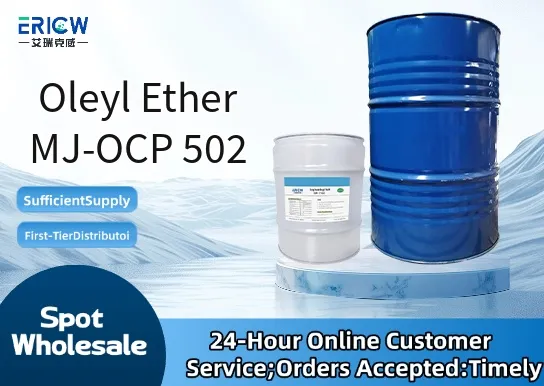
High-purity oleyl ether derivative with consistent alkyl chain distribution and low residual alcohol content.
Excellent hydrophobicity and thermal stability, supporting processing up to 220 °C without significant degradation.
Low volatility and negligible odor, enhancing operator safety and suitability for enclosed formulation environments.
Non-ionic surfactant functionality with balanced HLB (~8.5), enabling effective emulsification and wetting in complex matrices.
Readily dispersible in common organic solvents (e.g., xylene, isopropanol, ethyl acetate) and compatible with molten polymer systems.
Plasticizer and processing aid in thermoplastic elastomers (TPEs) and PVC compounds.
Internal lubricant and release modifier in engineering thermoplastics including polyamide (PA6/PA66) and polypropylene (PP).
Stabilizing co-additive in masterbatch formulations for pigment dispersion and melt flow enhancement.
Surface modifier in wax-based coatings and hot-melt adhesives to improve slip and anti-blocking performance.
Carrier fluid in controlled-release agricultural formulations requiring low aqueous solubility and high bioavailability retention.
| Chemical Type | Oleyl ether (mono-alkylated, saturated/unsaturated C18 mixed) |
| Product Form | Pale yellow to amber viscous liquid |
| Appearance | Clear, homogeneous liquid at 25 °C; slight cloud point near 12 °C |
| Melting Point | Approx. –12 °C to –8 °C (cloud point: 10–13 °C) |
| Primary Applications | Processing aid, internal lubricant, plasticizer alternative, carrier medium |
| Key Features | Low volatility, non-volatile residue <0.5 wt%, acid value ≤0.3 mg KOH/g |
| Benefits | Reduces melt viscosity, improves extrusion output, enhances surface finish, minimizes plate-out |
| Regulatory Compliance | REACH registered; compliant with EU Directive 2002/72/EC for food-contact plastics (subject to migration limits) |
| Common Compatible Systems | Suitability |
| Polyamide 6 (PA6) and PA66 | Highly Recommended – Excellent miscibility above 180 °C; no phase separation observed |
| Polypropylene (PP) homopolymer & copolymer | Recommended – Effective at 0.3–0.8 wt%; requires melt blending above 200 °C |
| PVC suspension resin (rigid & flexible) | Suitable – Functions as secondary plasticizer; synergistic with DOP/DINP below 170 °C |
| Ethylene-vinyl acetate (EVA) copolymers | Recommended – Enhances flexibility and hot-tack in adhesive formulations |
Q1: What is the CAS Registry Number for Oleyl Ether MJ-OCP 502?
A: The CAS number is 3687-46-5 (representing the predominant oleyl ether isomer fraction); full compositional data available upon request under NDA.
Q2: What is the recommended dosage range in polymer processing applications?
A: Typical usage is 0.2–0.6 wt% for internal lubrication in polyamides and PP; up to 1.2 wt% may be used in masterbatches or high-viscosity PVC systems — always validate via torque rheometry.
Q3: How does MJ-OCP 502 compare to traditional ester-based plasticizers like DEHP or DINP?
A: Unlike phthalates, MJ-OCP 502 is non-phthalate, non-migratory, and exhibits lower extraction in polar media; it provides superior thermal stability but lower primary plasticization efficiency — best used as a functional co-additive rather than full replacement.
Q4: Is MJ-OCP 502 compliant with FDA 21 CFR for indirect food contact?
A: It is not FDA-listed for direct food contact; however, it meets EU Framework Regulation (EC) No 1935/2004 and specific migration limits (<5 mg/kg) in polyolefin and polyamide food packaging when used within approved dosage and processing conditions.
Q5: Does MJ-OCP 502 exhibit migration or blooming in finished articles under accelerated aging?
A: Migration is minimal (<0.1 wt% after 1000 h at 60 °C per ISO 177); no surface blooming observed in PP or PA under standard storage conditions due to strong entanglement with polymer chains.
Contact With Us:
E-mail: wangxingqiang@ericwchem.com
Have a Questions? Call Us:
Add:
Building A1, Jiete Industrial Park, Huangpu District, Guangzhou City, Guangdong Province, China