English
 Español
 tiếng việt
 русский
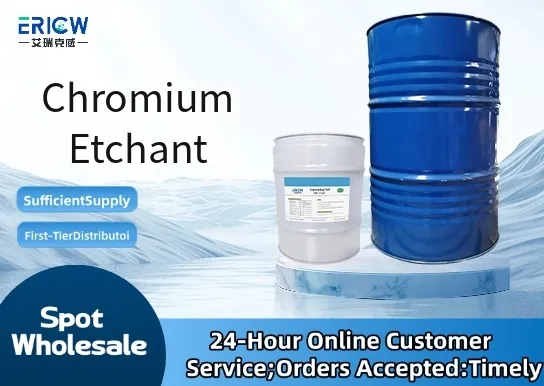
Highly selective etching of chromium and chromium oxide layers without significant undercutting of underlying substrates.
Stable aqueous formulation with extended bath life under controlled operating conditions.
Low volatility and minimal fuming—enhances workplace safety and reduces ventilation requirements.
pH-stabilized to prevent premature decomposition and ensure consistent etch rates.
Compatible with automated spray, dip, and immersion etching systems for high-volume production.
Etching of chromium thin films in semiconductor photomask fabrication.
Removal of chromium adhesion layers prior to lift-off processes in MEMS and microelectronics.
Surface preparation of chromium-plated components for bonding or coating adhesion enhancement.
Defect correction and localized trimming of Cr/CrOx layers on optical coatings and display substrates.
Controlled thinning of sputtered chromium layers in precision sensor manufacturing.
| Chemical Type | Aqueous acidic etchant (cerium(IV) ammonium nitrate–based) |
| Product Form | Liquid concentrate (ready-to-dilute) |
| Appearance | Clear, pale yellow to amber solution |
| Primary Applications | Chromium (Cr), chromium oxide (Cr2O3), and Cr-based alloy etching |
| Key Features | Non-hydrofluoric, non-cyanide, low-corrosivity to stainless steel fixtures |
| Benefits | Reduced environmental impact vs. traditional Cr(VI)-based etchants; compliant with RoHS and REACH SVHC screening |
| Regulatory Compliance | REACH registered; SDS available per GHS Rev. 8; not classified as PBT/vPvB |
| Storage Conditions | Store at 10–30°C in original container; protect from direct sunlight and freezing |
| Common Compatible Systems | Suitability |
| Stainless steel (316L) etch tanks and piping | Highly Recommended – Excellent corrosion resistance at operating temperatures ≤50°C |
| Polypropylene (PP) and PVDF immersion baths | Highly Recommended – No chemical degradation observed after 6-month exposure |
| Automated spray etchers with Teflon®-coated nozzles | Recommended – Requires periodic nozzle inspection due to potential crystalline residue buildup |
| Ultrasonic cleaning systems (stainless steel tank) | Suitable – Effective for small-part etching; avoid prolonged (>15 min) exposure at elevated temperature |
Q1: What is the CAS Registry Number for Chromium Etchant?
A: The primary active ingredient, cerium(IV) ammonium nitrate, has CAS No. 16774-21-3. The formulated product does not carry a single CAS number; full composition is disclosed in Section 3 of the Safety Data Sheet (SDS).
Q2: What is the recommended working concentration and typical etch rate?
A: Dilute 1:4 (v/v) with deionized water for standard use. At 25°C, average etch rate for 100 nm Cr film is 12–18 Å/sec; rate increases linearly with temperature up to 45°C.
Q3: How does this etchant compare to traditional chromium etchants containing chromic acid or ferric chloride?
A: Unlike chromic acid (Cr(VI), carcinogenic) or ferric chloride (highly corrosive, poor selectivity), this formulation uses Ce(IV) chemistry—non-carcinogenic, lower environmental persistence, superior Cr/substrate selectivity (>200:1 over Ti, Ni, and SiO₂), and easier waste treatment via Ce(III) precipitation.
Q4: Is there risk of metal ion migration or leaching into downstream process fluids?
A: Cerium ions exhibit very low solubility in neutral-to-basic rinse waters and do not migrate significantly into photoresist or polymer layers. Residual Ce on wafers is effectively removed by standard SC-1 (NH₄OH:H₂O₂:H₂O) clean; ICP-MS testing shows <0.05 ng/cm² residual after final rinse.
Contact With Us:
E-mail: wangxingqiang@ericwchem.com
Have a Questions? Call Us:
Add:
Building A1, Jiete Industrial Park, Huangpu District, Guangzhou City, Guangdong Province, China