English
 Español
 tiếng việt
 русский
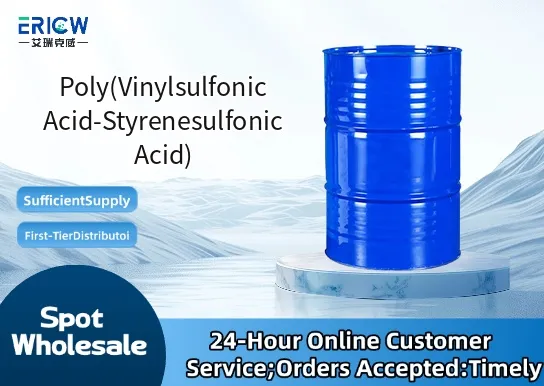
Highly water-soluble copolymer with strong acidic functionality from dual sulfonic acid groups.
Thermally stable up to 180 °C in solid state under inert atmosphere.
Tunable sulfonation density via vinylsulfonic acid (VSA) and styrenesulfonic acid (SSA) monomer ratio.
Excellent polyelectrolyte behavior with high charge density and low critical coagulation concentration (CCC).
Compatible with aqueous processing and scalable for industrial polymerization (e.g., solution or precipitation methods).
Proton exchange membranes (PEMs) for low-temperature fuel cells and electrolyzers.
Dispersant and stabilizer for aqueous pigment dispersions in waterborne coatings and inks.
Ion-conductive binder in lithium-ion and sodium-ion battery electrodes.
Functional additive in reverse osmosis and nanofiltration membrane fabrication.
Chelating agent for heavy metal removal in wastewater treatment formulations.
| Chemical Type | Sulfonated vinyl aromatic copolymer (random or gradient structure) |
| Product Form | White to off-white hygroscopic powder or lyophilized solid |
| Appearance | Free-flowing granular or amorphous powder |
| Melting Point | Decomposes above 220 °C (no sharp melting point; TGA onset ~215 °C) |
| Primary Applications | Electrolyte membranes, dispersants, battery binders, ion-exchange modifiers |
| Key Features | pH-responsive solubility, high ion-exchange capacity (IEC: 2.8–3.6 mmol/g), low residual monomers |
| Benefits | Enhanced proton conductivity vs. homopolymers, improved mechanical stability in wet state, reduced leaching in aqueous systems |
| Regulatory Compliance | Conforms to REACH Annex XIV exclusion criteria; no SVHCs listed at time of publication |
| Common Compatible Systems | Suitability |
| Water-based acrylic dispersions | Highly Recommended – Excellent colloidal stabilization without coagulation |
| Nafion®-based composite membranes | Recommended – Enhances proton conductivity and dimensional stability at ≤20 wt% loading |
| Aqueous LiFePO₄ slurry systems | Highly Recommended – Enables binder-free electrode processing with >95% active material retention |
| Polyethyleneimine (PEI) crosslinking networks | Suitable – Forms pH-responsive polyelectrolyte complexes; requires stoichiometric optimization |
Q1: What is the CAS Registry Number for Poly(Vinylsulfonic Acid-Styrenesulfonic Acid)?
A: This copolymer does not have a single CAS number due to compositional variability (VSA:SSA ratio, molecular weight distribution); lot-specific CAS assignments are provided upon request for registered customers.
Q2: What is the recommended dosage range in battery electrode slurries?
A: Typical usage is 0.5–2.0 wt% relative to total solids; optimal performance observed at 1.2 wt% for NMC622 cathodes with aqueous processing.
Q3: How does it compare to poly(styrenesulfonic acid) (PSSA) in terms of thermal stability and acidity?
A: Incorporation of vinylsulfonic acid units improves hydrolytic stability and lowers pKa (~0.8–1.2 vs. PSSA’s ~1.5–2.0), while thermal decomposition onset is comparable (±5 °C) under nitrogen.
Q4: Are extractables or migration levels compliant with FDA 21 CFR §175.300 for indirect food contact applications?
A: Not currently approved for food-contact use; intended for industrial and energy applications only. Migration testing data available upon formal request for specific formulation evaluation.
Contact With Us:
E-mail: wangxingqiang@ericwchem.com
Have a Questions? Call Us:
Add:
Building A1, Jiete Industrial Park, Huangpu District, Guangzhou City, Guangdong Province, China