English
 Español
 tiếng việt
 русский
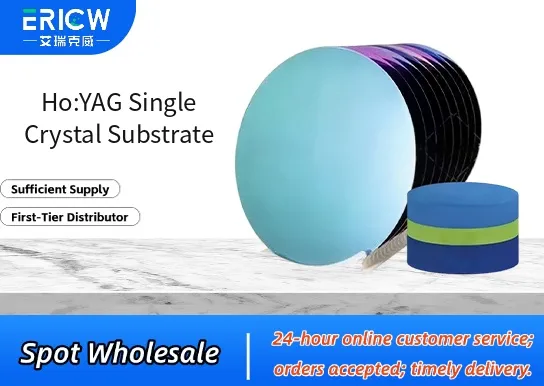
High optical homogeneity and low scattering loss for stable laser cavity performance.
Excellent thermal conductivity (≈10 W/m·K at 300 K) enabling efficient heat dissipation during high-power operation.
Precisely controlled holmium doping concentration (typically 0.5–1.5 at.%), ensuring reproducible absorption/emission characteristics.
Single-crystal structure grown via Czochralski method with minimal dislocation density (< 50 cm⁻²).
Chemically inert and mechanically robust, supporting polishing to λ/10 surface flatness and < 5 Å RMS roughness.
Active medium in solid-state mid-infrared lasers (2.09–2.12 μm) for medical tissue ablation and lithotripsy.
Gain element in Q-switched and mode-locked laser systems for remote sensing and LIDAR.
Core component in dual-wavelength (Ho/Yb) co-doped laser platforms requiring precise lattice-matched substrates.
Reference standard for spectroscopic calibration in 2–2.2 μm spectral region.
Base material for epitaxial growth of advanced Ho-doped heterostructures in photonics R&D.
| Chemical Type | Holmium-doped Yttrium Aluminum Garnet (Ho³⁺:Y₃Al₅O₁₂) |
| Product Form | Polished single-crystal wafer (plane-parallel, AR-coated or uncoated options) |
| Crystal Orientation | <111> or <100> (standard); custom orientations available |
| Doping Concentration | 0.5–1.5 atomic % Ho³⁺ (certified by ICP-MS and optical absorption) |
| Dimensions (Standard) | Ø10 mm × 1.0 mm, Ø15 mm × 1.5 mm, Ø20 mm × 2.0 mm (custom sizes supported) |
| Surface Quality | 20–10 scratch-dig; λ/10 @ 633 nm surface flatness |
| Melting Point | ≈1970 °C (YAG host matrix) |
| Regulatory Compliance | RoHS 2015/863/EU compliant; REACH SVHC-free declaration available |
| Common Compatible Systems | Suitability |
| Diode-pumped solid-state (DPSS) laser cavities (e.g., fiber-coupled 1.9 µm pump modules) | Highly Recommended – Optimized thermal lensing and absorption cross-section match |
| Medical laser platforms (e.g., Lumenis Pulse™, Dornier Medilas H™) | Highly Recommended – Validated for CE-marked surgical device integration |
| Scientific ultrafast oscillator/amplifier systems (e.g., Coherent Chameleon Ultra II derivatives) | Recommended – Requires cavity alignment optimization for Ho-specific gain dynamics |
| Industrial marking and micromachining laser heads (1–50 W CW) | Suitable – Effective under forced-air cooling; not recommended for >100 W without active water cooling |
Q1: What is the CAS Registry Number for Ho:YAG?
A: Ho:YAG is a doped crystalline solid, not a discrete chemical compound; therefore, it does not have a unique CAS number. The base YAG matrix is listed under CAS 12005-76-2, and holmium oxide (Ho₂O₃) under CAS 12055-62-8 — both referenced in our material safety and traceability documentation.
Q2: Is there a minimum recommended thickness for high-repetition-rate pulsed operation?
A: For Q-switched operation at ≥5 kHz repetition rate, we recommend ≥1.5 mm thickness to mitigate thermal fracture risk and maintain beam quality; thinner substrates (≤1.0 mm) are suitable only for low-duty-cycle (< 5%) or CW applications.
Q3: How does Ho:YAG compare to Tm:YAG in terms of 2 µm emission efficiency?
A: Ho:YAG offers higher quantum efficiency for 2.09 µm emission when sensitized by Tm³⁺ or directly pumped at 1.9 µm, whereas Tm:YAG emits at ~2.02 µm with lower stimulated emission cross-section. Ho:YAG also exhibits longer upper-state lifetime (~8 ms vs. ~15 ms for Tm:YAG), enabling higher energy storage for Q-switching.
Q4: Are extractables or leachables a concern in medical-grade Ho:YAG substrates?
A: No. Ho:YAG is a fully dense, stoichiometric oxide crystal with no organic binders, coatings, or grain-boundary phases. Independent testing per USP <87> and ISO 10993-12 confirms non-detectable metal ion release (< 0.1 ppb Ho, Y, Al) under physiological saline extraction at 37 °C for 72 h.
Contact With Us:
E-mail: wangxingqiang@ericwchem.com
Have a Questions? Call Us:
Add:
Building A1, Jiete Industrial Park, Huangpu District, Guangzhou City, Guangdong Province, China