English
 Español
 tiếng việt
 русский
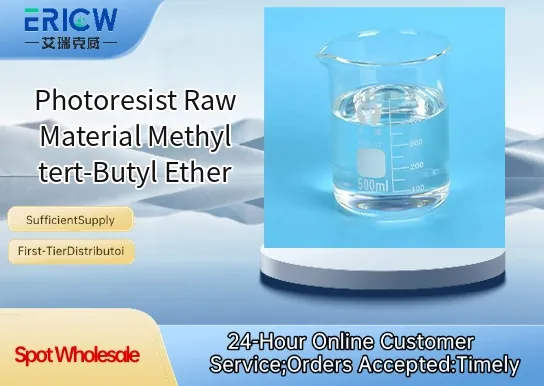
High-purity solvent specifically refined for photoresist formulation to minimize particulate and ionic contamination.
Low water content (<50 ppm) ensures consistent resist film uniformity and reduces defect formation during spin-coating.
Controlled volatility profile enables precise drying kinetics in pre-bake (soft bake) stages without skinning or bubble formation.
Chemically inert toward common photoacid generators (PAGs), resins (e.g., novolac, PHS), and dissolution inhibitors.
Non-reactive with stainless steel and fluoropolymer wetted materials, supporting compatibility with high-purity delivery systems.
Primary solvent carrier in g-line and i-line positive-tone photoresists for semiconductor front-end manufacturing.
Co-solvent in advanced KrF (248 nm) resist formulations to modulate dissolution rate and improve lithographic contrast.
Cleaning agent for photomask blanks and reticle handling tools where low-residue evaporation is critical.
Process aid in resist rework solutions for selective removal of unexposed features without substrate attack.
Stabilizing medium for photosensitive polymer dispersions used in OLED display patterning processes.
| Chemical Type | Organic ether solvent |
| Product Form | Clear, colorless liquid |
| Appearance | Transparent, free from suspended matter |
| Melting Point | −14 °C |
| Boiling Point (at 760 mmHg) | 55.2 °C |
| Primary Applications | Photoresist solvent, process cleaner, co-formulation aid |
| Key Features | Ultra-low metals (Na, K, Fe < 1 ppb), total halides < 5 ppb, non-peroxide forming |
| Regulatory Compliance | REACH registered; meets SEMI S2/S8 safety guidelines; no SVHC on current EU candidate list |
| Common Compatible Systems | Suitability |
| Novolac-based g/i-line resists (e.g., Shipley 1813, Tokyo Ohka PG-2000 series) | Highly Recommended – Proven solvent performance with minimal swelling or residue |
| KrF chemically amplified resists (e.g., JSR APEX-E, Shin-Etsu UV-111) | Recommended – Requires blending with PGMEA; optimal at ≤30 wt% loading |
| Automated resist dispensing systems (e.g., TOK Coatmaster™, Screen DSC-100) | Highly Recommended – Low viscosity and rapid evaporation support stable meniscus control |
| Photomask cleaning platforms (e.g., Semitool ECP, Lam AquaSolve) | Suitable – Effective for organic residue removal; compatible with quartz and Cr-on-glass substrates |
Q1: What is the CAS Registry Number for Methyl tert-butyl ether used in photoresist applications?
A: The CAS number is 1634-04-4. Our photoresist-grade material is manufactured under strict traceability protocols and certified per batch for identity and purity.
Q2: Can MTBE replace PGMEA entirely in a KrF resist formulation?
A: Not as a full substitute—MTBE has lower polarity and solvating power for polyhydroxystyrene (PHS) resins. It is typically used at ≤25 wt% alongside PGMEA to fine-tune evaporation rate and reduce standing wave effects.
Q3: Does MTBE exhibit extractable leachables that could impact device yield in advanced nodes?
A: No detectable leachables (e.g., tert-butanol, formaldehyde, or MTBE itself) are observed post-bake under standard litho conditions (90–120 °C, 60 sec). GC-MS analysis confirms <0.1 ppb residual in baked films at 28 nm node equivalent processing.
Q4: Is this grade compliant with USP/EP specifications for electronic-grade solvents?
A: While not classified under pharmacopeial monographs, it conforms to SEMI C37 (Electronic Grade Solvents) and IPC-CC-830B Annex B requirements for ionic purity, particulates (<1 particle/mL @ ≥0.2 µm), and outgassing profiles.
Contact With Us:
E-mail: wangxingqiang@ericwchem.com
Have a Questions? Call Us:
Add:
Building A1, Jiete Industrial Park, Huangpu District, Guangzhou City, Guangdong Province, China