English
 Español
 tiếng việt
 русский
High-resolution patterning capability with sub-micron resolution (≤ 0.8 µm) under standard i-line (365 nm) exposure.
Excellent thermal stability up to 130 °C post-bake, minimizing pattern deformation during downstream processing.
Fast and uniform development in standard 0.26 N TMAH aqueous solution with high contrast (γ > 5.0).
Low outgassing behavior during vacuum-based processes, reducing contamination risk in lithography clusters.
Consistent lot-to-lot performance validated by in-house QC using SEM metrology and CD uniformity analysis.
Microelectromechanical systems (MEMS) fabrication requiring high aspect ratio etch compatibility.
Semiconductor packaging photolithography, including redistribution layer (RDL) and bump mask applications.
Flexible printed electronics manufacturing on PET and PI substrates.
Optical waveguide patterning for integrated photonics devices.
Maskless direct-write lithography in R&D and low-volume prototyping environments.
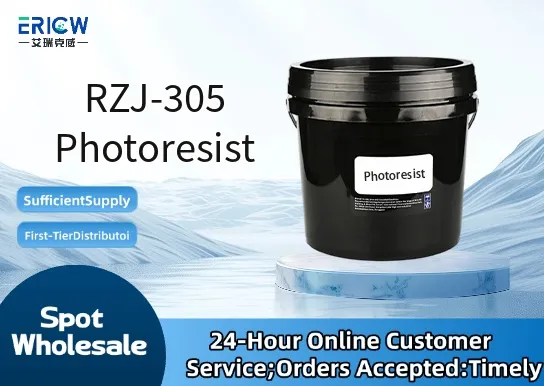
| Chemical Type | Negative-tone, novolac resin–based with diazonaphthoquinone (DNQ) sensitizer |
| Product Form | Ready-to-use liquid solution in PGMEA solvent |
| Appearance | Clear, pale yellow, particle-free liquid |
| Viscosity (25 °C) | 22–24 cP (measured per ASTM D445) |
| Primary Applications | i-line (365 nm) photolithography for MEMS, packaging, and micro-optics |
| Key Features | High sensitivity (~40–60 mJ/cm²), low standing wave effect, good adhesion to Si, SiO₂, and Cu |
| Benefits | Reduced process cycle time, improved yield in high-mix production, compatible with automated dispense systems |
| Regulatory Compliance | REACH compliant; RoHS 2015/863 Annex II verified; no SVHCs above threshold |
| Common Compatible Systems | Suitability |
| ASML PAS 5500 / i-line steppers | Highly Recommended – Optimized focus-exposure matrix (FEM) and overlay performance validated |
| Canon FPA-3000 i-line scanners | Highly Recommended – Full support for auto-alignment and dose calibration protocols |
| Screen Printing & Dispense Platforms (e.g., DEK Horizon) | Recommended – Compatible with precision spin-coating modules; requires pre-filtering through 0.2 µm PTFE filter |
| Track Systems (Tokyo Electron CLEAN TRACK LITHIUS) | Suitable – Verified integration with ACT-8 and ACT-12 process modules; minor recipe tuning advised |
Q1: What is the CAS Registry Number for RZJ-305 Photoresist?
A: RZJ-305 is a proprietary multi-component formulation; individual constituents have CAS numbers (e.g., PGMEA: 108-65-6, DNQ: 1337-24-2), but the final product is not assigned a single CAS number per IUPAC and regulatory guidance for complex mixtures.
Q2: What is the recommended coating thickness and corresponding spin speed for RZJ-305 on silicon wafers?
A: At 3000 rpm (30 sec), typical dry film thickness is 1.8–2.2 µm on bare Si; thickness scales predictably from 2000 rpm (≈3.0 µm) to 4000 rpm (≈1.2 µm). Thickness verification via ellipsometry or cross-sectional SEM is recommended for critical layers.
Q3: How does RZJ-305 compare to RZJ-200 series in terms of resolution and process window?
A: RZJ-305 offers higher resolution (≤0.8 µm vs. ≥1.2 µm for RZJ-200) and wider depth-of-focus (DOF > 1.1 µm at 0.9 µm line/space), achieved via optimized resin molecular weight distribution and enhanced DNQ photochemistry — ideal for advanced packaging where RZJ-200 remains suitable for coarse-feature applications.
Q4: Is RZJ-305 compliant with food-contact or medical device regulations (e.g., USP Class VI, ISO 10993)?
A: No — RZJ-305 is formulated exclusively for industrial semiconductor and microfabrication use. It is not intended, tested, or certified for food-contact surfaces, implantable devices, or biological applications. Residual monomer and solvent content are not evaluated per USP/ISO biocompatibility standards.
Q5: Has migration or extractables testing been performed for RZJ-305 under thermal stress (e.g., 120 °C for 2 hrs)?
A: Yes — GC-MS analysis of extracts from thermally cured RZJ-305 films (120 °C/2 h) confirmed <0.5 ppm total volatile organic extractables; major residuals were trace PGMEA and methyl phenol (<0.1 ppm each), well below ICH Q3C thresholds for pharmaceutical manufacturing equipment coatings.
Contact With Us:
E-mail: wangxingqiang@ericwchem.com
Have a Questions? Call Us:
Add:
Building A1, Jiete Industrial Park, Huangpu District, Guangzhou City, Guangdong Province, China