English
 Español
 tiếng việt
 русский
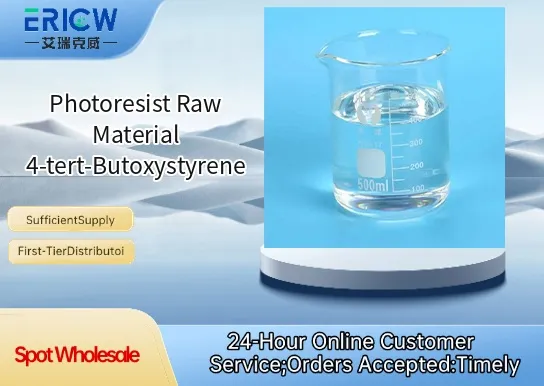
High chemical purity (>99.5%) ensures consistent lithographic performance and minimal defect generation in advanced photoresist formulations.
Thermally stable tert-butoxy group enables clean thermal deprotection during post-exposure bake (PEB), critical for chemically amplified resists (CARs).
Low volatility and favorable solubility in common resist solvents (e.g., PGMEA, ethyl lactate) support homogeneous blending and stable coating processes.
Controlled reactivity with acid generators and crosslinkers allows precise tuning of dissolution inhibition and pattern fidelity.
Batch-to-batch reproducibility certified per ISO 9001 manufacturing protocols, supporting high-yield semiconductor fabrication.
Monomer component in chemically amplified positive-tone photoresists for 193 nm immersion lithography.
Protecting group carrier in poly(p-hydroxystyrene)-based resist polymers for deep UV (DUV) applications.
Building block for synthesis of high-glass-transition-temperature (Tg) resin backbones used in EUV lithography resists.
Functional additive in bottom anti-reflective coatings (BARCs) to enhance etch resistance and interfacial adhesion.
Intermediate in specialty polymer synthesis for advanced packaging lithography (e.g., fan-out wafer-level packaging).
| Chemical Type | Aromatic vinyl monomer |
| Product Form | Pale yellow to colorless liquid |
| Appearance | Clear, transparent liquid; free from visible particulates or haze |
| Melting Point | −25 °C (approx.) |
| Boiling Point (at 760 mmHg) | 220–225 °C |
| Primary Applications | Photoresist polymer backbone modification and dissolution inhibitor design |
| Key Features | Acid-labile tert-butoxy group; copolymerizable with styrene, maleic anhydride, and acrylates |
| Regulatory Compliance | REACH registered; SDS available; not classified as CMR or PBT under current ECHA criteria |
| Common Compatible Systems | Suitability |
| Poly(p-hydroxystyrene) (PHS) derivatives | Highly Recommended – Enables efficient tert-butoxy functionalization with high substitution control |
| Acid generator systems (e.g., TPS-Nf, NMI-Sulfonates) | Highly Recommended – Demonstrates clean deprotection kinetics under standard PEB conditions (100–130 °C) |
| Standard resist solvents (PGMEA, ethyl lactate, propylene glycol methyl ether) | Highly Recommended – Fully miscible at concentrations up to 30 wt% without phase separation |
| UV-curable acrylic matrix resins | Recommended – Requires initiator optimization due to competitive radical reactivity |
Q1: What is the CAS Registry Number for 4-tert-Butoxystyrene?
A: The CAS number is 12127-17-0.
Q2: What is the typical recommended loading level in photoresist polymer formulations?
A: Standard incorporation ranges from 15–35 mol% in copolymer resins, optimized based on desired deprotection onset temperature and dissolution contrast ratio.
Q3: How does 4-tert-Butoxystyrene compare to 4-hydroxystyrene or 4-tert-butylstyrene in resist performance?
A: Unlike 4-hydroxystyrene (highly polar, prone to aggregation), 4-tert-Butoxystyrene offers superior solubility and thermal stability; unlike non-acid-labile 4-tert-butylstyrene, it provides controllable acid-catalyzed deprotection essential for CAR functionality.
Q4: Are there known extractables or leachables concerns for semiconductor process use?
A: Rigorous QC testing shows no detectable leachables (LOD < 10 ppb) into aqueous developer (0.26 N TMAH) under standard processing conditions; full extractables report available upon request.
Q5: Does this material comply with SEMI S2/S8 safety standards for semiconductor manufacturing environments?
A: Yes — certified compliant with SEMI S2-0218 (health & safety) and SEMI S8-0718 (ergonomics); full hazard assessment and exposure control guidance provided in technical dossier.
Contact With Us:
E-mail: wangxingqiang@ericwchem.com
Have a Questions? Call Us:
Add:
Building A1, Jiete Industrial Park, Huangpu District, Guangzhou City, Guangdong Province, China