English
 Español
 tiếng việt
 русский
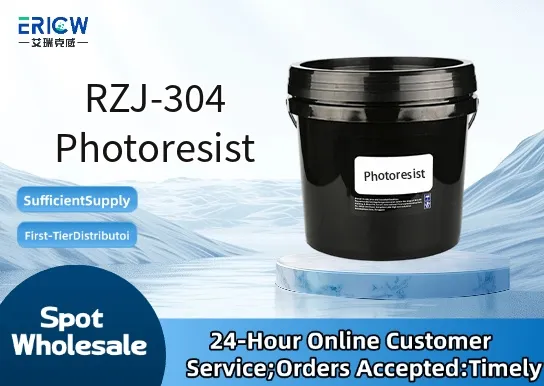
High-resolution patterning capability with sub-micron resolution (≤ 0.8 µm line/space) under standard i-line exposure.
Excellent thermal stability up to 130 °C, enabling robust post-exposure bake and etch processes.
Low outgassing profile suitable for vacuum-compatible lithography tools and cleanroom environments.
Broad developer compatibility—optimized for standard 0.26 N TMAH aqueous solutions.
Consistent film-forming performance across spin-coating speeds (2,000–5,000 rpm), ensuring uniform thickness control.
Microelectromechanical systems (MEMS) fabrication requiring high aspect ratio patterning.
Semiconductor packaging substrates including fan-out wafer-level packaging (FOWLP).
Advanced display driver ICs and touch sensor electrode patterning.
Optoelectronic device manufacturing such as VCSEL and photodetector arrays.
Research and pilot-line lithography in university and industrial nanofabrication facilities.
| Chemical Type | Positive-tone, novolac-diazonaphthoquinone (DNQ) based photoresist |
| Product Form | Liquid concentrate (ready-to-use, filtered to 0.2 µm) |
| Appearance | Clear, pale yellow to amber homogeneous solution |
| Viscosity (25 °C) | 22–26 cP (measured per ASTM D445) |
| Solid Content | 18–20 wt% (by gravimetric analysis) |
| Primary Applications | i-line (365 nm) lithography for semiconductor, MEMS, and advanced packaging |
| Key Features | High photospeed (~40–60 mJ/cm²), low standing wave effect, minimal dark erosion |
| Regulatory Compliance | REACH SVHC-free; RoHS 2015/863 compliant; non-halogenated formulation |
| Common Compatible Systems | Suitability |
| ASML PAS 5500 / i-line steppers | Highly Recommended – Validated for <1.0 µm resolution at 40–55 mJ/cm² dose |
| Canon FPA-3000 i-line scanners | Highly Recommended – Full process window qualification completed |
| SVGL MicraScan III | Recommended – Requires minor focus offset adjustment (+0.15 µm) |
| Spin coaters (e.g., SUSS MicroTec ACS200, Tokyo Electron CLEAN TRACK) | Suitable – Compatible with standard dispense and soft-bake modules |
Q1: What is the CAS Registry Number for RZJ-304 Photoresist?
A: RZJ-304 is a proprietary multi-component formulation; individual CAS numbers are assigned to key constituents only — e.g., DNQ sensitizer (CAS 22937-78-2), novolac resin blend (CAS 9003-35-4). Full composition disclosure requires signed CDA.
Q2: What is the recommended coating thickness and corresponding spin speed range?
A: Target thickness: 1.2–1.8 µm (after soft bake). Achieved via spin coating at 2,500–4,000 rpm (30 sec); exact speed depends on desired thickness and substrate geometry.
Q3: How does RZJ-304 compare to RZJ-301 in terms of resolution and process latitude?
A: RZJ-304 offers ~20% higher resolution (0.8 µm vs. 1.0 µm) and wider focus latitude (±0.4 µm vs. ±0.25 µm) due to optimized DNQ concentration and resin molecular weight distribution.
Q4: Are extractables or leachables data available for use in medical device lithography?
A: Yes — USP <788> particulate testing and ISO 10993-12 extractables profiling (in water, 50% ethanol/water, and saline at 50 °C/72 h) are available upon request under NDA.
Q5: Does RZJ-304 comply with EU Directive 2011/65/EU (RoHS 2) and China RoHS II?
A: Yes — certified RoHS 2 and China RoHS II compliant (SJ/T 11364-2014); full declaration and test reports (SGS IEC 62321-3-1:2013) provided with bulk shipments.
Contact With Us:
E-mail: wangxingqiang@ericwchem.com
Have a Questions? Call Us:
Add:
Building A1, Jiete Industrial Park, Huangpu District, Guangzhou City, Guangdong Province, China