English
 Español
 tiếng việt
 русский
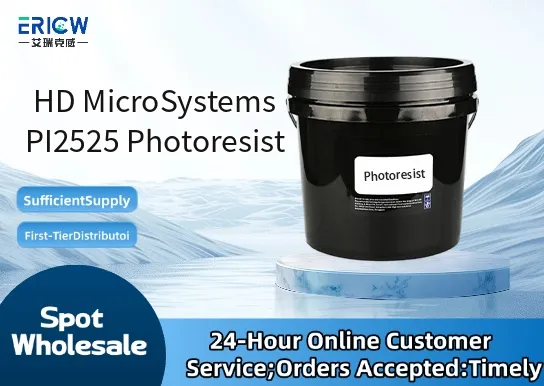
High-resolution negative-tone photoresist optimized for advanced microfabrication processes.
Excellent thermal stability with glass transition temperature (Tg) > 300 °C after cure.
Low outgassing profile suitable for vacuum and space-qualified applications.
Superb adhesion to silicon, silicon dioxide, metals (e.g., Al, Cu), and polyimide substrates.
Compatible with standard UV exposure tools (i-line, g-line) and deep-UV (248 nm) lithography systems.
Fabrication of MEMS and MOEMS devices requiring high-aspect-ratio patterning.
Passivation and interlayer dielectric layers in flexible electronics and display backplanes.
Stencils and shadow masks for precision thin-film deposition in R&D and pilot production.
Wafer-level packaging (WLP) and redistribution layer (RDL) patterning in advanced IC packaging.
Micro-optics and diffractive optical element (DOE) manufacturing.
| Chemical Type | Polyimide-based negative-tone photosensitive resin |
| Product Form | Ready-to-use liquid solution (solvent: gamma-butyrolactone) |
| Appearance | Clear, amber-colored viscous liquid |
| Viscosity (25 °C) | ~1,200 – 1,600 cP (as supplied) |
| Primary Applications | High-temperature stable patterning, permanent passivation, structural layers |
| Key Features | Post-bake stability up to 400 °C; low coefficient of thermal expansion (CTE) |
| Benefits | Reduces need for additional hard masks; enables single-layer process integration |
| Regulatory Compliance | RoHS 2015/863 compliant; REACH SVHC-free (as per latest declaration) |
| Common Compatible Systems | Suitability |
| SVGL MicraStep i-line Stepper | Highly Recommended – Optimized exposure dose and focus latitude confirmed |
| Karlsruhe Institute of Technology (KIT) Maskless Lithography Tool (MLL) | Recommended – Requires minor dose calibration; full resolution maintained |
| Canon FPA-3030 i-Line Scanner | Highly Recommended – Qualified for production use at ≤ 3 µm L/S resolution |
| ASML PAS 5500/300 (i-line) | Suitable – Validated for R&D workflows; process window characterization available upon request |
Q1: What is the CAS Registry Number for PI2525?
A: The CAS number for HD MicroSystems PI2525 Photoresist is 181799-50-2 (for the proprietary polyimide precursor formulation).
Q2: What is the typical spin-coating thickness range and corresponding spin speed?
A: At 2,500–4,000 rpm, PI2525 yields uniform films from 1.5 µm to 8.0 µm (depending on solids content and substrate). Recommended starting point: 3,200 rpm → ~4.5 µm dry film.
Q3: How does PI2525 compare to PI2611 in terms of resolution and thermal budget?
A: PI2525 offers superior resolution (< 2 µm L/S vs. ~3.5 µm for PI2611) and higher post-cure thermal stability (Tg > 300 °C vs. ~270 °C), making it preferred for fine-pitch MEMS and high-reliability packaging.
Q4: Is PI2525 compliant with USP Class VI and ISO 10993 for biomedical device applications?
A: PI2525 is not certified to USP Class VI or ISO 10993. It is intended for industrial microfabrication only; biological compatibility testing is the responsibility of the end-user under their regulatory pathway.
Q5: Are there documented data on extractables or leachables under elevated temperature/humidity conditions?
A: Extractables data are available in the PI2525 Technical Dossier (Revision D, 2023). Under IPC-TM-650 2.3.27 conditions (85 °C / 85% RH, 168 h), total organic extractables are < 12 ppm by GC-MS; no halogenated organics detected.
Contact With Us:
E-mail: wangxingqiang@ericwchem.com
Have a Questions? Call Us:
Add:
Building A1, Jiete Industrial Park, Huangpu District, Guangzhou City, Guangdong Province, China