English
 Español
 tiếng việt
 русский
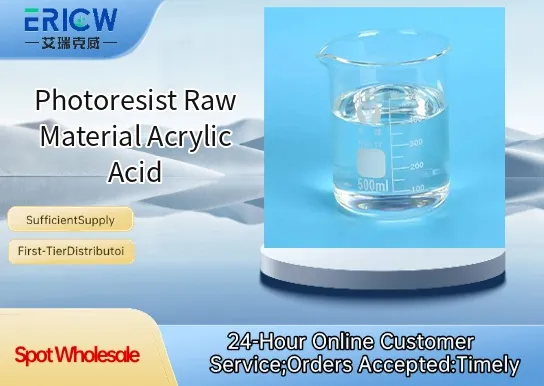
High-purity monomer with ≥99.5% assay, minimizing residue-induced defects in photolithographic patterning.
Low inhibitor content (MEHQ ≤10 ppm) ensures optimal polymerization control during resist formulation.
Consistent batch-to-batch reactivity and molecular weight distribution for reproducible photoresist performance.
Ultra-low ionic impurities (Na⁺, K⁺, Cl⁻ < 1 ppm each) critical for semiconductor-grade cleanroom compatibility.
Stabilized for long-term storage under refrigerated, nitrogen-blanketed conditions without significant dimerization.
Core monomer in positive-tone acrylic-based photoresists for advanced semiconductor lithography (i-line, KrF, ArF).
Functional comonomer in chemically amplified resists (CARs) to modulate dissolution rate and contrast.
Building block for poly(acrylic acid)-based resin matrices used in display manufacturing (LCD/OLED color filter patterning).
Reactive component in UV-curable photoresist formulations for MEMS and microfluidic device fabrication.
Intermediate in synthesis of acrylic ester derivatives (e.g., tert-butyl acrylate) for protected resist polymers.
| Chemical Type | Unsaturated carboxylic acid monomer |
| Product Form | Liquid (inhibitor-stabilized) |
| Appearance | Clear, colorless to pale yellow liquid |
| Melting Point | 13–14 °C |
| Boiling Point (at 760 mmHg) | 141 °C |
| Primary Applications | Photoresist polymer synthesis, acrylic copolymer backbone |
| Key Features | High reactivity, low volatility residual, semiconductor-grade purity |
| Regulatory Compliance | REACH registered; RoHS compliant; non-REACH SVHC candidate (as of latest update) |
| Common Compatible Systems | Suitability |
| KrF Excimer Laser Lithography Systems | Highly Recommended – Excellent transparency at 248 nm and controlled acid-catalyzed deprotection kinetics |
| ArF Immersion Lithography Platforms | Recommended – Requires co-monomer blending (e.g., with hydroxystyrene) to enhance etch resistance |
| UV-Curable Inkjet Resist Deposition Systems | Suitable – Compatible with cationic/photoinitiator blends for low-temperature patterning |
| Spin-Coating Resist Formulation Lines (Semiconductor Fab) | Highly Recommended – Fully compatible with standard solvent systems (PGMEA, EL, cyclohexanone) |
Q1: What is the CAS Registry Number for this grade of acrylic acid?
A: The CAS number is 79-10-7. This refers specifically to the high-purity, inhibitor-stabilized grade certified for photoresist synthesis.
Q2: What is the typical recommended loading level of acrylic acid in a photoresist polymer formulation?
A: Loading typically ranges from 20–45 mol% in terpolymer systems (e.g., with maleic anhydride and styrene derivatives), optimized per dissolution inhibition profile and lithographic resolution requirements.
Q3: How does this acrylic acid grade differ from technical-grade acrylic acid in resist applications?
A: Technical-grade acrylic acid contains higher levels of aldehydes, heavy metals, and dimer impurities that cause scumming, linewidth variation, and post-exposure bake instability — unsuitable for sub-100 nm lithography.
Q4: Are there documented extraction or migration studies for acrylic acid residues in final semiconductor devices?
A: Yes — validated IC-MS and TOF-SIMS data confirm residual acrylic acid monomer is fully consumed during polymerization and post-apply bake (PAB); no detectable leaching observed after full process integration (detection limit: <0.05 ppb).
Contact With Us:
E-mail: wangxingqiang@ericwchem.com
Have a Questions? Call Us:
Add:
Building A1, Jiete Industrial Park, Huangpu District, Guangzhou City, Guangdong Province, China