English
 Español
 tiếng việt
 русский
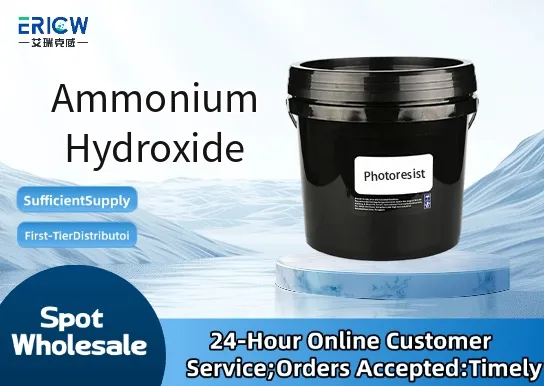
High-purity aqueous solution of ammonia, typically available in concentrations from 5% to 30% w/w NH₃.
Versatile pH adjuster with strong alkaline properties (pH ~11.6 for 10% solution at 25°C).
Readily biodegradable and leaves no persistent residues upon neutralization or evaporation.
Non-oxidizing base—minimizes risk of unwanted side reactions in sensitive chemical syntheses.
Supplied in corrosion-resistant HDPE or lined carbon steel containers compatible with standard handling infrastructure.
Neutralization agent in pharmaceutical intermediate synthesis and API purification processes.
pH control reagent in semiconductor wafer cleaning and photoresist stripping formulations.
Nutrient source and pH stabilizer in agricultural foliar fertilizers and hydroponic nutrient solutions.
Catalyst and complexing agent in metal finishing, electroplating baths, and copper etching solutions.
Odor control and ammoniation agent in wastewater treatment and municipal sludge stabilization.
| Chemical Type | Aqueous ammonia solution (NH₃ in H₂O) |
| Product Form | Clear, colorless liquid |
| Appearance | Free of suspended solids and turbidity |
| Primary Applications | pH adjustment, complexation, nitrogen source, cleaning agent |
| Key Features | Volatile base, low heavy metal content, consistent batch-to-batch performance |
| Benefits | Ease of removal via volatilization, minimal ash residue, compatibility with food-contact and pharma-grade systems |
| Regulatory Compliance | Meets USP/NF, FCC, and ACS reagent grade requirements (where applicable); compliant with REACH and TSCA |
| Storage Stability | 12 months in sealed, cool, well-ventilated conditions; avoid exposure to direct sunlight |
| Common Compatible Systems | Suitability |
| Stainless Steel (304/316) | Highly Recommended – Excellent resistance to stress corrosion cracking under controlled concentration and temperature |
| HDPE & PP Piping/Tanks | Highly Recommended – Chemically inert and widely used for storage and transfer |
| Carbon Steel (with epoxy lining) | Recommended – Lining prevents corrosion; unlined carbon steel not advised |
| Glass-Lined Reactors | Suitable – Resistant to alkaline attack; avoid thermal shock during addition |
| PVC and CPVC | Suitable – Acceptable for low-concentration (<10%) ambient applications; limited service life above 25°C |
Q1: What is the CAS Number for Ammonium Hydroxide?
A: The CAS Registry Number is 1336-21-6 (for aqueous ammonia, commonly referenced as ammonium hydroxide).
Q2: How should Ammonium Hydroxide be handled to minimize ammonia vapor exposure?
A: Use only in well-ventilated areas or under local exhaust ventilation; wear chemical-resistant gloves, splash goggles, and an organic vapor respirator when handling >10% solutions. Always add slowly to water—not vice versa—to control exothermic release.
Q3: Is Ammonium Hydroxide suitable for food-grade or pharmaceutical manufacturing?
A: Yes—when supplied to FCC, USP/NF, or EP specifications, it is approved for use as a processing aid, pH adjuster, and nutrient in food, dietary supplements, and pharmaceutical manufacturing per FDA 21 CFR §184.1139 and ICH Q5C guidelines.
Q4: Does Ammonium Hydroxide migrate or leach from packaging into products?
A: Migration is negligible in properly selected packaging (e.g., HDPE, fluoropolymer-lined tanks). Due to its volatility, residual ammonia readily dissipates during downstream processing; validated extractables studies confirm low migration potential under GMP-compliant storage and use conditions.
Contact With Us:
E-mail: wangxingqiang@ericwchem.com
Have a Questions? Call Us:
Add:
Building A1, Jiete Industrial Park, Huangpu District, Guangzhou City, Guangdong Province, China