English
 Español
 tiếng việt
 русский
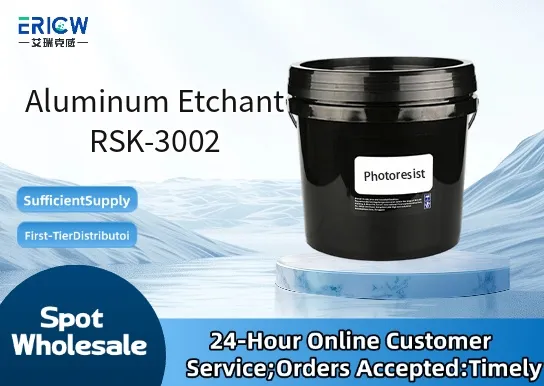
Highly selective etching for aluminum and aluminum alloys with minimal attack on masking resists and underlying substrates.
Non-hydrofluoric acid (HF-free) formulation ensuring improved workplace safety and reduced regulatory burden.
Stable bath life with consistent etch rate control over extended operational cycles.
Low foaming and excellent wetting properties for uniform processing in spray, dip, and immersion systems.
Compatible with standard stainless steel and PVC/PVDF process equipment without aggressive corrosion concerns.
Microelectronic packaging: removal of aluminum layers in leadframe and substrate patterning.
Aerospace component surface preparation prior to anodizing or coating adhesion enhancement.
Automotive heat exchanger fin and tube etching for improved thermal interface performance.
Architectural aluminum cladding texturing and matte finish development.
Printed circuit board (PCB) aluminum base layer definition in hybrid metal-core substrates.
| Chemical Type | Acidic aqueous solution (phosphoric–nitric–acetic acid blend) |
| Product Form | Liquid concentrate (ready-to-dilute) |
| Appearance | Clear, colorless to pale yellow liquid |
| pH (as supplied) | 1.0 – 1.5 (25 °C) |
| Density (25 °C) | 1.12 – 1.16 g/cm³ |
| Primary Applications | Controlled aluminum dissolution in precision manufacturing |
| Key Features | HF-free, low metal ion carryover, resist-compatible, non-oxidizing to copper |
| Regulatory Compliance | REACH compliant; SDS available; not classified as PBT/vPvB under EU criteria |
| Common Compatible Systems | Suitability |
| Vertical spray etchers (e.g., SCREEN, Tokyo Electron) | Highly Recommended – Optimized flow dynamics and temperature stability up to 45 °C |
| Batch immersion tanks (stainless steel 316L or PP-lined) | Highly Recommended – No measurable corrosion after 90 days continuous exposure |
| Inline conveyorized dip systems with PVC piping | Recommended – Requires periodic pH and concentration monitoring |
| Ultrasonic cleaning/etching modules (40–80 kHz) | Suitable – Effective for fine-feature etching; avoid prolonged cavitation at >55 °C |
Q1: What is the CAS Registry Number for Aluminum Etchant RSK-3002?
A: RSK-3002 is a proprietary multi-component formulation; individual ingredients have CAS numbers (e.g., phosphoric acid: 7664-38-2; nitric acid: 7697-37-2), but the blended product is not assigned a single CAS number per IUPAC and EPA guidelines.
Q2: What is the recommended working concentration and typical etch rate?
A: Dilute 1:4 to 1:9 (v/v) with deionized water; typical etch rate for pure aluminum (1100 alloy) is 0.8–1.2 µm/min at 30 °C, adjustable via temperature and agitation control.
Q3: How does RSK-3002 compare to traditional HF-based aluminum etchants?
A: RSK-3002 eliminates acute toxicity and dermal penetration risks associated with HF, offers easier wastewater neutralization, and avoids silicon etching—making it ideal for aluminum-on-silicon or Al/SiO₂ structures where HF would cause undercut or substrate damage.
Q4: Does RSK-3002 meet RoHS and ELV directives for automotive electronics?
A: Yes—RSK-3002 contains no restricted substances above threshold limits (Pb, Cd, Hg, Cr⁶⁺, PBB, PBDE); full compliance documentation and test reports are provided upon request.
Q5: Is there risk of metal ion migration or extractables when used on medical-grade aluminum components?
A: No significant leaching of heavy metals or organic residuals occurs; validated per USP <87> and <88> cytotoxicity testing on finished parts shows no adverse response under standard rinse protocols (3x DI water, 60 °C).
Contact With Us:
E-mail: wangxingqiang@ericwchem.com
Have a Questions? Call Us:
Add:
Building A1, Jiete Industrial Park, Huangpu District, Guangzhou City, Guangdong Province, China