English
 Español
 tiếng việt
 русский
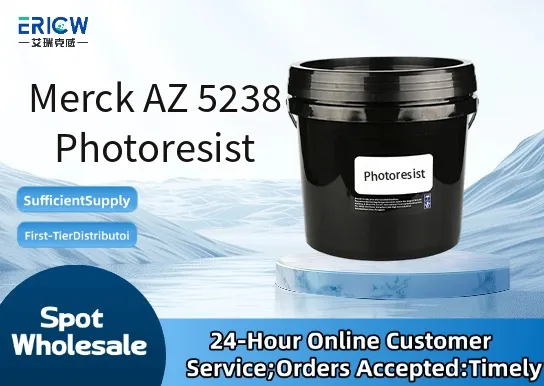
High-resolution positive-tone imaging capability with sub-micron resolution down to 0.8 µm using i-line (365 nm) exposure.
Excellent thermal stability and post-exposure bake (PEB) latitude, enabling robust process control in high-volume manufacturing.
Superior adhesion to silicon, silicon dioxide, and metal substrates without requiring additional primers such as HMDS.
Low outgassing profile suitable for vacuum-compatible lithography processes and EUV-preparatory environments.
Consistent batch-to-batch performance validated per Merck’s ISO 9001-certified production standards.
Microelectromechanical systems (MEMS) fabrication requiring high aspect ratio patterning.
Power semiconductor device manufacturing, including IGBTs and SiC diodes.
Advanced packaging lithography for redistribution layers (RDL) and fan-out wafer-level packaging (FOWLP).
MEMS sensor and actuator patterning on glass and quartz substrates.
Research and development of novel optoelectronic and photonic integrated circuits (PICs).
| Chemical Type | Novolac resin-based positive photoresist with diazonaphthoquinone (DNQ) photosensitizer |
| Product Form | Liquid solution in proprietary solvent blend (non-halogenated) |
| Appearance | Clear, amber-colored, homogeneous liquid |
| Viscosity (23 °C, 100 rpm) | 24–26 cP (measured per ASTM D2196) |
| Solid Content | 22.5 ± 0.5 wt% |
| Primary Applications | i-line (365 nm) photolithography for 0.8–3.0 µm feature sizes |
| Key Features | High sensitivity (~40–60 mJ/cm²), low standing wave effect, minimal swelling during development |
| Regulatory Compliance | REACH compliant; RoHS 2011/65/EU compliant; no SVHCs above threshold per current candidate list |
| Common Compatible Systems | Suitability |
| ASML PAS 5500 / i-line steppers | Highly Recommended – Optimized exposure dose and focus settings available in Merck Process Guide |
| TOK Coater/Developer Systems (e.g., CLEAN TRACK LITHIUS P) | Highly Recommended – Pre-qualified with standard dispense and spin parameters |
| Canon FPA-3030i4/i5 steppers | Recommended – Requires minor PEB temperature calibration (±2 °C) |
| EVG 620 mask aligners | Suitable – Validated for contact/proximity mode; reduced resolution vs. projection tools |
Q1: What is the CAS Registry Number for AZ 5238?
A: The CAS number for Merck AZ 5238 Photoresist is 137920-25-9 (assigned to the formulated product).
Q2: What is the typical coating thickness range and recommended spin speed?
A: At 23 °C, spin speeds of 2000–4000 rpm yield dry film thicknesses of 1.2–0.6 µm, respectively; optimal uniformity achieved at 3000 rpm ± 100 rpm.
Q3: How does AZ 5238 compare to AZ 5214E in terms of resolution and etch resistance?
A: AZ 5238 offers higher resolution (≤0.8 µm vs. ≥1.2 µm for AZ 5214E) and improved plasma etch resistance due to optimized novolac molecular weight distribution, but lower contrast than AZ 5214E in thick-film applications.
Q4: Is AZ 5238 compliant with food contact or medical device regulations?
A: No — AZ 5238 is not certified for food contact (FDA 21 CFR) or medical device applications (ISO 10993). It is intended exclusively for microfabrication in electronics and industrial R&D.
Q5: Are there data available on extractables or leachables under thermal stress conditions?
A: Yes — Merck provides an Extractables Profile Report (EP-5238-01) detailing volatile organic compounds (VOCs) and semi-volatiles released below 200 °C; full report available under NDA upon request.
Contact With Us:
E-mail: wangxingqiang@ericwchem.com
Have a Questions? Call Us:
Add:
Building A1, Jiete Industrial Park, Huangpu District, Guangzhou City, Guangdong Province, China