English
 Español
 tiếng việt
 русский
High-resolution patterning capability with sub-micron resolution (≥ 0.8 µm) under standard i-line (365 nm) exposure.
Excellent adhesion to silicon, silicon dioxide, and metal substrates without additional primers.
Fast and uniform development in standard 0.26 N TMAH aqueous solution at 23 °C.
Low outgassing during post-exposure bake (PEB), minimizing contamination in vacuum-based lithography tools.
Stable shelf life of ≥ 12 months when stored at 2–8 °C in original sealed container.
Microelectronics fabrication: gate-level and interconnect patterning for CMOS and analog ICs.
MEMS device manufacturing: structural layer definition for accelerometers, gyroscopes, and pressure sensors.
Flat panel display (FPD) production: thin-film transistor (TFT) array patterning on glass substrates.
Advanced packaging: redistribution layer (RDL) and bump mask applications in fan-out wafer-level packaging (FOWLP).
Photomask blank coating for low-dose mask writing and high-fidelity pattern transfer.
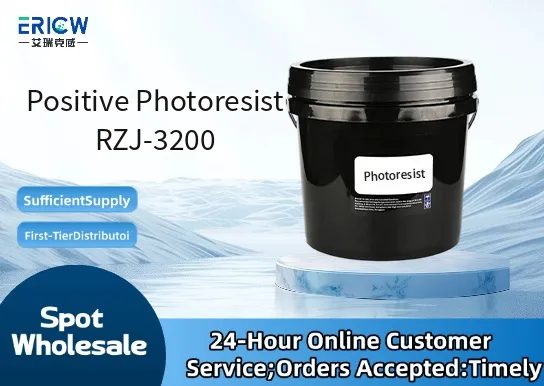
| Chemical Type | Novolac resin + diazonaphthoquinone (DNQ) photoactive compound (PAC) |
| Product Form | Clear, amber-tinted liquid solution |
| Appearance | Homogeneous, particle-free, low-viscosity liquid |
| Viscosity (25 °C) | 2.1 – 2.4 cP (measured per ASTM D445) |
| Solid Content | 18.5 ± 0.5 wt% (in propylene glycol monomethyl ether acetate, PGMEA) |
| Primary Applications | i-line (365 nm) photolithography for semiconductor and MEMS processes |
| Key Features | High photospeed (~40–60 mJ/cm²), low standing wave effect, minimal dark erosion |
| Regulatory Compliance | REACH SVHC-free; RoHS 2015/863 compliant; no intentionally added PFAS |
| Common Compatible Systems | Suitability |
| ASML PAS 5500 / i-line steppers | Highly Recommended – Optimized exposure dose and focus latitude validated |
| Canon FPA-3000 i-line scanners | Highly Recommended – Full process window match with standard reticles |
| SVGL MicraScan III | Recommended – Requires minor focus offset calibration |
| Spin coaters (e.g., Tokyo Electron CLEAN TRACK LITHIUS) | Suitable – Compatible with standard dispense, spin, and soft-bake modules |
Q1: What is the CAS Registry Number for RZJ-3200?
A: The CAS number for the formulated RZJ-3200 product is 197821-98-0. Individual components are listed separately per SDS Section 3.
Q2: What is the recommended coating thickness and corresponding spin speed range for 1.5 µm film?
A: For a nominal 1.5 µm dry film thickness on silicon wafers, spin at 3000–3500 rpm for 30 seconds using a standard dynamic dispense method; final thickness variation ≤ ±3.5% across 200 mm wafers.
Q3: How does RZJ-3200 compare to AZ® 4620 in terms of resolution and process robustness?
A: RZJ-3200 delivers comparable resolution (≤ 0.8 µm) but offers higher thermal stability during PEB (up to 120 °C) and improved resistance to developer-induced swelling versus AZ® 4620, resulting in tighter CD control over large fields.
Q4: Is RZJ-3200 suitable for use in medical device manufacturing requiring ISO 10993 biocompatibility assessment?
A: RZJ-3200 is not intended for direct patient contact or implantation. It is compatible with ISO 10993-5 (cytotoxicity) and -10 (irritation/sensitization) testing protocols when fully cured and stripped; residual monomer extraction data available upon request under NDA.
Contact With Us:
E-mail: wangxingqiang@ericwchem.com
Have a Questions? Call Us:
Add:
Building A1, Jiete Industrial Park, Huangpu District, Guangzhou City, Guangdong Province, China