English
 Español
 tiếng việt
 русский
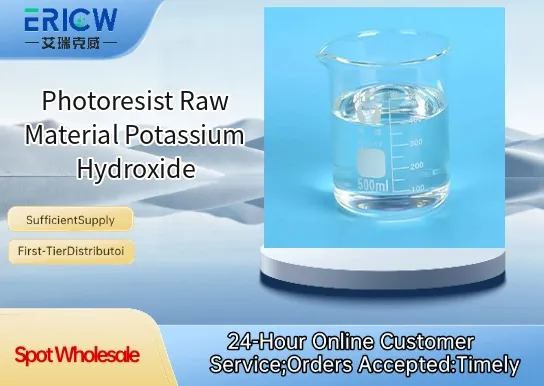
Ultra-high purity grade (≥99.99% KOH) with trace metal impurities strictly controlled to sub-ppb levels for semiconductor-grade photoresist formulation.
Consistent particle size distribution and low moisture content (<0.1%) to ensure reproducible dissolution kinetics in aqueous developer systems.
Stabilized packaging under inert atmosphere (N₂) to prevent carbonate formation and maintain alkalinity stability during storage and handling.
Batch-to-batch analytical certification (ICP-MS, titration, Karl Fischer) supporting IATF 16949 and ISO 9001 traceability requirements.
Alkaline developer component in positive-tone photoresists for advanced lithography (i-line, KrF, ArF immersion).
pH modulator and dissolution rate enhancer in chemically amplified resists (CARs) for high-resolution patterning.
Key raw material in TMAH-free alternative developer formulations targeting EUV lithography process compatibility.
Controlled etch accelerator in resist stripping and post-etch residue removal solutions for 300 mm wafer fabs.
| Chemical Type | Inorganic alkali, potassium hydroxide (KOH) |
| Product Form | White crystalline granules or pellets (optional ultra-fine powder upon request) |
| Appearance | Free-flowing, non-caking white solid; no visible discoloration or foreign particles |
| Melting Point | 360 °C (decomposes above 400 °C) |
| Primary Applications | Photoresist developer formulation, CAR dissolution control, wafer cleaning chemistry |
| Key Features | Low Na⁺, Fe, Ni, Cu, Cr (<1 ppb each by ICP-MS), minimal K₂CO₃ (<50 ppm) |
| Benefits | Improved critical dimension uniformity (CDU), reduced microbridge defects, extended bath life |
| Regulatory Compliance | REACH SVHC-free, RoHS 3 compliant, no California Prop 65 listed substances |
| Common Compatible Systems | Suitability |
| Standard aqueous photoresist developers (e.g., 0.26 N KOH-based) | Highly Recommended – Optimized for consistent dissolution rate and low defect generation |
| Multi-component developer blends (KOH + organic co-solvents + surfactants) | Recommended – Requires pre-mix compatibility testing for long-term colloidal stability |
| Recycled developer reclamation systems (e.g., ion exchange + ultrafiltration) | Suitable – Demonstrated recovery efficiency >92% without carbonate accumulation |
| TMAH-substituted high-resolution developer platforms | Highly Recommended – Validated for <10 nm node patterning in pilot line trials |
Q1: What is the CAS Number for semiconductor-grade potassium hydroxide used in photoresist applications?
A: The CAS Number is 1310-58-3. Our photoresist-grade material carries a dedicated lot-specific Certificate of Analysis confirming identity, purity, and trace elemental profile per SEMI C37 standards.
Q2: What is the typical concentration range used in photoresist developer formulations?
A: Concentrations typically range from 0.15 N to 0.30 N (≈0.84–1.68 wt%) in deionized water. Higher concentrations may be used in specialized high-throughput tools but require strict temperature and filtration control.
Q3: How does this KOH differ from technical-grade or food-grade potassium hydroxide?
A: Unlike general-purpose grades, our photoresist-grade KOH undergoes double-zone refining, ultra-clean packaging (ISO Class 5 cleanroom), and full trace metal profiling—ensuring Na⁺, Fe, and heavy metals remain below detection limits critical for sub-7 nm lithography yield.
Q4: Is leaching or ion migration into photoresist films a concern during storage or processing?
A: No significant migration occurs under standard conditions. KOH remains fully dissociated in aqueous developer solution and does not penetrate cured resist films; residual surface ions are removed during standard rinse/dry steps per SEMI F57 guidelines.
Q5: Does this material comply with USP/EP pharmaceutical excipient standards?
A: Not applicable — this product is manufactured and qualified exclusively for semiconductor photolithography use per SEMI standards. It is not certified for pharmaceutical, cosmetic, or food applications.
Contact With Us:
E-mail: wangxingqiang@ericwchem.com
Have a Questions? Call Us:
Add:
Building A1, Jiete Industrial Park, Huangpu District, Guangzhou City, Guangdong Province, China