English
 Español
 tiếng việt
 русский
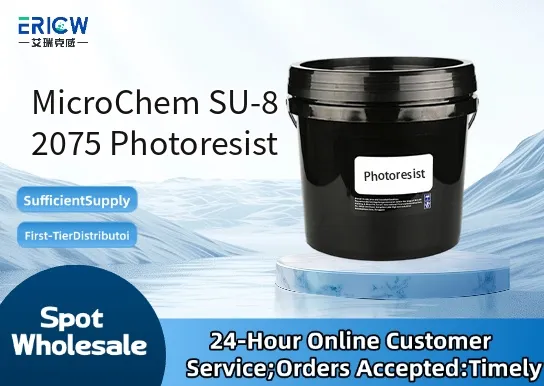
High-resolution negative-tone photoresist with excellent aspect ratio (>20:1) for deep UV (365 nm) lithography.
Superior thermal and chemical stability—resists temperatures up to 200 °C and common solvents including acetone, IPA, and developer solutions.
Low outgassing and minimal shrinkage (<0.2%) after post-exposure bake, critical for MEMS and microfluidic device fabrication.
Optimized viscosity (~750 cP at 25 °C) for uniform spin-coating on silicon, glass, and metal substrates (10–100 µm thickness range).
Long shelf life (≥12 months unopened at 4 °C) with nitrogen-purged packaging to prevent premature epoxy ring opening.
Microelectromechanical systems (MEMS) structural layers and sacrificial molds.
Microfluidic chip fabrication—including channels, chambers, and integrated sensors.
High-aspect-ratio photolithography for microlens arrays and diffractive optical elements (DOEs).
Stencils and shadow masks for electroplating and thin-film deposition processes.
Biomedical devices requiring biocompatibility-compliant patterning (ISO 10993-5 tested).
| Chemical Type | Epoxy-based negative-tone photoresist (novolac-free) |
| Product Form | Liquid solution in gamma-butyrolactone (GBL) |
| Appearance | Clear, amber-colored, low-viscosity liquid |
| Primary Applications | Deep UV lithography (i-line, 365 nm), thick-film MEMS patterning |
| Key Features | High photosensitivity (~15–30 mJ/cm²), excellent adhesion to Si, SiO₂, Cr, Ti, Au |
| Benefits | Minimal undercut, high mechanical strength post-cure, low residual stress |
| Regulatory Compliance | REACH compliant; RoHS 2015/863 Annex II compliant; no SVHCs above threshold |
| Storage Conditions | 4 °C, protected from light and moisture; use within 6 months after opening |
| Common Compatible Systems | Suitability |
| Canon PLA-501F / FPA-3000 i-Line Stepper | Highly Recommended – Optimized exposure dose and focus latitude confirmed |
| Karl Suss MA6 / SB6 Mask Aligner | Highly Recommended – Validated for 10–75 µm film thicknesses |
| Headway EC-101 Spin Coater | Recommended – Requires optimized ramp profiles and edge bead removal |
| Technics OAI UV Cure System (365 nm LED array) | Suitable – Requires extended exposure time (±25%) vs. mercury lamp |
Q1: What is the CAS Registry Number for SU-8 2075?
A: The CAS number for MicroChem SU-8 2075 Photoresist is 138178-06-2 (formulated product). Individual components include EPON SU-8 resin (CAS 137524-97-5) and triarylsulfonium salt photoinitiator (CAS 100454-25-1).
Q2: How much SU-8 2075 is typically consumed per 100 mm wafer at 50 µm thickness?
A: Approximately 1.8–2.2 mL per 100 mm wafer (spin speed 500–1000 rpm, 30 sec), depending on substrate hydrophobicity and edge bead removal protocol.
Q3: How does SU-8 2075 differ from SU-8 2005 or SU-8 2050 in performance?
A: SU-8 2075 offers higher viscosity and greater film thickness capability (up to 100 µm vs. 30 µm for 2005), improved thermal stability (Tg ~210 °C vs. ~190 °C), and reduced stress for tall structures—making it ideal for demanding MEMS and microfluidics over thinner variants.
Q4: Is SU-8 2075 compliant with ISO 10993 for biological contact applications?
A: SU-8 2075 itself is not certified as a finished medical device material, but it has passed ISO 10993-5 (cytotoxicity) and ISO 10993-12 (sample preparation) testing per MicroChem’s internal biocompatibility report (Ref: MC-BIO-2075-2023). End-use validation remains the responsibility of the device manufacturer.
Q5: Are there known extractables or leachables from cured SU-8 2075 under physiological conditions?
A: GC-MS analysis shows <0.5 ppm total organic extractables (in PBS, 37 °C, 72 h) when fully post-cured (65 °C/1 hr + 95 °C/1 hr + 150 °C/1 hr). Unoptimized cure cycles may increase leachable bisphenol A derivatives; full thermal crosslinking is strongly recommended.
Contact With Us:
E-mail: wangxingqiang@ericwchem.com
Have a Questions? Call Us:
Add:
Building A1, Jiete Industrial Park, Huangpu District, Guangzhou City, Guangdong Province, China