English
 Español
 tiếng việt
 русский
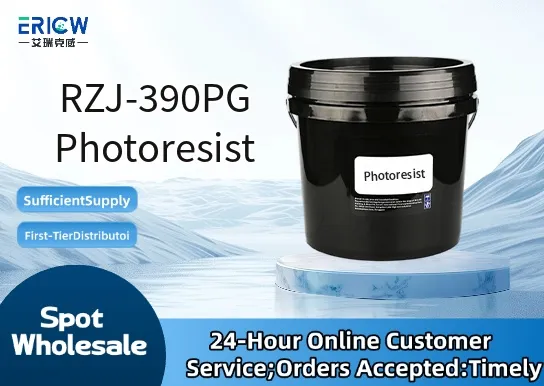
High-resolution patterning capability with sub-micron resolution (≤ 0.8 µm) under standard i-line (365 nm) exposure.
Excellent thermal stability up to 120 °C post-bake, minimizing pattern deformation during subsequent processing steps.
Low outgassing profile suitable for vacuum-compatible lithography environments and sensitive deposition processes.
Optimized adhesion to silicon, SiO₂, and metal substrates (e.g., Al, Ti, Cr) without mandatory HMDS priming.
Consistent film uniformity (< ±3% thickness variation across 200 mm wafers) when spin-coated at 2500–4000 rpm.
Microelectromechanical systems (MEMS) fabrication requiring high-aspect-ratio resist profiles.
Semiconductor packaging lithography, including redistribution layer (RDL) and bump mask patterning.
Flexible printed electronics manufacturing on PET and PI substrates.
MEMS sensor prototyping and low-volume production in university and R&D cleanrooms.
Advanced display driver IC patterning where thermal budget and line-edge roughness (LER) are critical.
| Chemical Type | Positive-tone novolac-diazonaphthoquinone (DNQ) photoresist |
| Product Form | Liquid solution (solvent: propylene glycol monomethyl ether acetate – PGMEA) |
| Appearance | Clear, pale yellow liquid, free of visible particles or gels |
| Viscosity (25 °C) | 2.8–3.2 cP (measured per ASTM D445) |
| Primary Applications | i-line (365 nm) photolithography for MEMS, packaging, and R&D |
| Key Features | High sensitivity (~40–60 mJ/cm²), low standing wave effect, good develop rate control |
| Benefits | Reduced process cycle time, improved CD uniformity, compatibility with aqueous TMAH developers |
| Regulatory Compliance | REACH SVHC-free; RoHS 3 compliant; non-halogenated formulation |
| Common Compatible Systems | Suitability |
| ASML PAS 5500 / i-line steppers | Highly Recommended – Validated for full-field exposure and overlay accuracy ≤ 120 nm |
| Karlstad KLA-Tencor UVision track systems | Recommended – Compatible with standard bake/develop modules; minor recipe tuning advised |
| Canon FPA-3030i4 stepper | Highly Recommended – Certified for high-throughput production use with integrated focus control |
| Manual spin coaters (e.g., Laurell WS-650MZ-23NPPB) | Suitable – Delivers repeatable films; requires calibrated dispense volume and ramp profile |
Q1: What is the CAS Registry Number for RZJ-390PG Photoresist?
A: RZJ-390PG is a proprietary multi-component formulation; individual CAS numbers apply to major constituents (e.g., DNQ: 2475-45-8; novolac resin blend: mixture not assigned single CAS). Full composition disclosure is available under NDA.
Q2: What is the typical coating thickness and recommended spin speed range?
A: At 3000 rpm, achieves ~1.2 µm dry film thickness on silicon; thickness scales predictably from 0.8 µm (4000 rpm) to 2.1 µm (1500 rpm). Optimized for 2500–3500 rpm in production.
Q3: How does RZJ-390PG compare to G-line resists like AZ 4562 in terms of resolution and process latitude?
A: RZJ-390PG offers superior resolution (≤ 0.8 µm vs. ≥ 1.5 µm for AZ 4562) and wider depth-of-focus (DOF > 1.8 µm) under i-line, but requires tighter exposure dose control (±5% vs. ±10% for G-line).
Q4: Is RZJ-390PG compliant with ISO 10993 for biocompatibility testing?
A: RZJ-390PG is not intended for direct biological contact and has not undergone ISO 10993 evaluation. Residual monomer and solvent extraction profiles meet SEMI S2-0219 safety thresholds for semiconductor tool handling.
Q5: What is the expected extractable content after development and hard bake?
A: Total volatile organic extractables (per IEC 60112) are < 0.08 wt% after standard post-exposure bake (PEB) at 110 °C for 60 s and development in 0.26 N TMAH.
Contact With Us:
E-mail: wangxingqiang@ericwchem.com
Have a Questions? Call Us:
Add:
Building A1, Jiete Industrial Park, Huangpu District, Guangzhou City, Guangdong Province, China