English
 Español
 tiếng việt
 русский
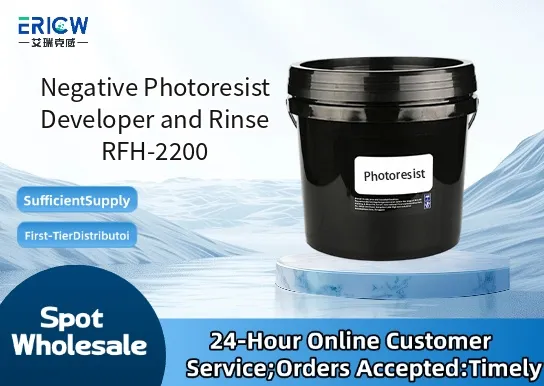
Optimized aqueous-based formulation for high-resolution development of conventional novolac-diazonaphthoquinone (DNQ) negative photoresists.
Low foaming and excellent rinse efficiency, minimizing residue and reducing post-develop defect density.
Consistent performance across wide temperature and concentration ranges (20–25 °C, 1:2 to 1:4 dilution with DI water).
Non-corrosive to aluminum, titanium, and stainless-steel wet processing equipment.
Stable shelf life (>18 months unopened; >6 months in-use when stored at 15–25 °C).
Microelectromechanical systems (MEMS) fabrication requiring high-aspect-ratio pattern fidelity.
Power semiconductor packaging lithography, including leadframe and substrate patterning.
Display driver IC manufacturing using thick-film negative resists (e.g., SU-8 derivatives).
Flexible printed circuit (FPC) base film patterning with polyimide-compatible process flows.
Industrial sensor and automotive electronics photomask-less direct-write applications.
| Chemical Type | Aqueous alkaline developer with proprietary surfactant and chelating agents |
| Product Form | Liquid concentrate (ready-to-dilute) |
| Appearance | Clear, colorless to pale yellow solution |
| pH (1:3 dilution, 25 °C) | 11.2 ± 0.3 |
| Primary Applications | Development and inline rinse for DNQ-based negative photoresists |
| Key Features | Low particle generation, low metal ion content (<10 ppb Na/K/Ca/Mg), non-halogenated |
| Benefits | Reduced microbridging, improved CD uniformity, compatibility with automated track dispensing |
| Regulatory Compliance | REACH SVHC-free, RoHS 2015/863 compliant, no listed Prop 65 carcinogens |
| Common Compatible Systems | Suitability |
| TOK NLD-1000 series negative resists | Highly Recommended – Validated for full process window (exposure dose, development time, PEB) |
| MicroChem SU-8 2000 & 3000 series | Recommended – Requires optimized rinse time; validated for <50 µm film thickness |
| JSR TMMR-E series (epoxy-based) | Suitable – Compatible with standard spray develop/rinse cycles; confirm adhesion via wafer-level test |
| Canon PL-2700 series | Recommended – Demonstrated linewidth control ≤3 µm with 0.5 NA stepper exposure |
Q1: What is the CAS Registry Number for RFH-2200?
A: RFH-2200 is a proprietary multi-component formulation; individual ingredients are disclosed under confidentiality agreement, and no single CAS number applies. Full ingredient disclosure is available upon execution of an NDA and request for SDS Appendix B.
Q2: What is the recommended working concentration and dwell time for 20 µm SU-8 2075?
A: For 20 µm SU-8 2075, use 1:3 dilution (RFH-2200:DI water) at 23 °C with 60–90 seconds spray development followed by 30 seconds cascade rinse. Adjust dwell time ±15 sec based on exposure energy (typically 120–180 mJ/cm²).
Q3: How does RFH-2200 compare to standard 0.26 N TMAH in terms of residue and sidewall profile?
A: RFH-2200 delivers superior residue removal versus 0.26 N TMAH—particularly on high-topography substrates—due to its engineered surfactant system. It yields near-vertical sidewalls (≥88°) with reduced scumming, while TMAH often exhibits undercut or micro-masking at resist interfaces.
Q4: Is RFH-2200 certified for use in medical device manufacturing per ISO 10993 or USP Class VI?
A: RFH-2200 is not individually certified to ISO 10993 or USP Class VI, as it is a process chemical—not a final device component. However, extractables testing per USP <87> and <88> (cytotoxicity, systemic injection) has been performed on wafers processed with RFH-2200; results meet Class VI acceptance criteria when used within validated parameters.
Q5: Does RFH-2200 contribute to leachable amines or alkylphenol ethoxylates (APEOs) in final rinsate?
A: No. RFH-2200 contains zero APEOs and uses amine-free buffering agents. Total organic carbon (TOC) analysis of final rinse effluent shows <0.1 ppm residual organics, with no detectable primary or secondary amines (LOD: 5 ppb via LC-MS/MS).
Contact With Us:
E-mail: wangxingqiang@ericwchem.com
Have a Questions? Call Us:
Add:
Building A1, Jiete Industrial Park, Huangpu District, Guangzhou City, Guangdong Province, China