English
 Español
 tiếng việt
 русский
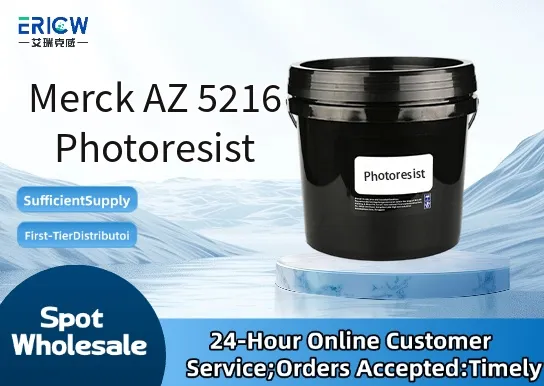
High-resolution positive-tone photoresist optimized for g-line (436 nm) and i-line (365 nm) lithography.
Excellent thermal stability and post-exposure bake (PEB) latitude for robust process control.
Superior adhesion to silicon, silicon dioxide, and metal substrates without requiring HMDS priming in many standard processes.
Low outgassing behavior suitable for vacuum-compatible microfabrication environments.
Consistent lot-to-lot performance with tight specifications on viscosity and solids content.
Microelectromechanical systems (MEMS) fabrication requiring fine feature definition and high aspect ratio patterning.
Photomask manufacturing for semiconductor and display industries.
Microfluidic device prototyping and production using silicon or glass substrates.
Sensor chip patterning in automotive and industrial electronics applications.
Research and development of hybrid integrated circuits and thin-film devices.
| Chemical Type | Novolac resin-based positive photoresist with diazonaphthoquinone (DNQ) photoactive compound |
| Product Form | Liquid solution in ethyl lactate and propylene glycol monomethyl ether acetate (PGMEA) |
| Appearance | Clear, pale yellow to amber homogeneous liquid |
| Viscosity (23 °C, cps) | 15–17 cP (as supplied) |
| Solids Content (wt %) | 20.5–21.5% |
| Primary Applications | g-line/i-line photolithography for mask making, MEMS, and R&D |
| Key Features | High sensitivity (~40–60 mJ/cm² at i-line), good resolution down to 1.0 µm line/space |
| Regulatory Compliance | REACH compliant; RoHS 2015/863 Annex II compliant; no SVHCs above threshold |
| Common Compatible Systems | Suitability |
| Canon FPA-3000 i-line Stepper | Highly Recommended – Validated for sub-2 µm resolution with standard process conditions |
| ASML PAS 5500/300 g-line Scanner | Recommended – Requires minor focus and exposure dose optimization |
| SVGL MicraStep i-line Stepper | Recommended – Compatible with standard spin-coating and develop parameters |
| Mask Aligners (e.g., Karl Suss MA6/MJB4) | Suitable – Proven for contact/proximity printing up to 3 µm resolution |
Q1: What is the CAS Number for AZ 5216 Photoresist?
A: AZ 5216 is a proprietary formulation; it does not have a single CAS number. Individual components are listed under their respective CAS numbers in the Safety Data Sheet (SDS), available upon request from Merck Technical Support.
Q2: What is the typical spin-coating thickness and recommended spin speed range?
A: At 23 °C, spin speeds of 3000–4500 rpm yield dry film thicknesses of 1.2–1.8 µm; exact thickness depends on substrate, ambient humidity, and soft-bake profile.
Q3: How does AZ 5216 compare to AZ 5214E in terms of resolution and process window?
A: AZ 5216 offers higher resolution (≤1.0 µm vs. ~1.5 µm for AZ 5214E) and improved PEB latitude, but narrower development time tolerance; AZ 5214E provides superior image reversal capability, which AZ 5216 does not support.
Q4: Is AZ 5216 compliant with FDA or EU food-contact regulations?
A: No — AZ 5216 is not intended nor qualified for food-contact or medical implant applications; it is strictly for microfabrication use in controlled industrial settings.
Q5: Are there documented studies on extractables or leachables from AZ 5216 residues after plasma etch or ash removal?
A: Residual carbon and trace organics from incomplete ash removal may remain; Merck recommends O₂ plasma descum followed by RCA clean for critical applications. Full extractables data is confidential and available only under NDA to qualified customers.
Contact With Us:
E-mail: wangxingqiang@ericwchem.com
Have a Questions? Call Us:
Add:
Building A1, Jiete Industrial Park, Huangpu District, Guangzhou City, Guangdong Province, China