English
 Español
 tiếng việt
 русский
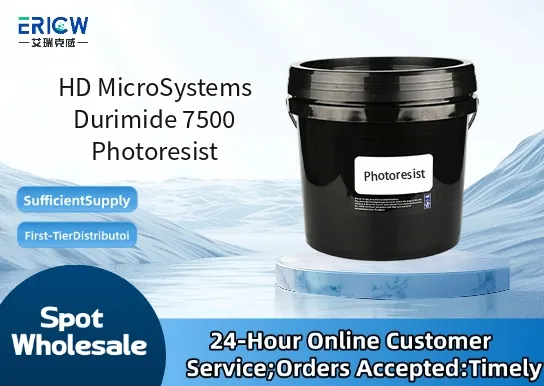
High-resolution negative-tone imaging capability with sub-micron resolution down to 0.5 µm.
Excellent thermal stability—cured films withstand continuous operation up to 400 °C.
Low outgassing and minimal residue after plasma etch, ideal for vacuum and MEMS environments.
Superior adhesion to silicon, silicon dioxide, silicon nitride, and metal substrates (e.g., Al, Cu, TiW).
Wide process latitude with robust exposure and development windows in standard g-line and i-line lithography tools.
MEMS device fabrication—including accelerometers, gyroscopes, and pressure sensors.
Wafer-level packaging (WLP) and redistribution layer (RDL) patterning.
High-temperature stable passivation and interlayer dielectric (ILD) applications.
Microfluidic channel definition and bio-MEMS device encapsulation.
RF and microwave components requiring low-loss, dimensionally stable polyimide structures.
| Chemical Type | Negative-tone, photosensitive polyimide precursor |
| Product Form | Spin-coatable liquid solution (NMP-based) |
| Appearance | Amber-to-light-brown viscous liquid |
| Primary Applications | High-temperature stable patterning, MEMS, WLP, RDL, hermetic encapsulation |
| Key Features | Photopatternable without separate photoactive compound (PAC); self-imaging chemistry |
| Benefits | Eliminates post-apply bake (PAB) step; single-layer process reduces cycle time and defect density |
| Regulatory Compliance | RoHS 2015/863 compliant; REACH SVHC-free (as declared); no intentionally added PFAS |
| Storage Conditions | 2–8 °C, protected from light and moisture; shelf life: 12 months unopened |
| Common Compatible Systems | Suitability |
| Canon FPA-3000 i-line Stepper | Highly Recommended – Optimized exposure dose: 120–180 mJ/cm²; full-field uniformity < ±3% |
| Tokyo Electron (TEL) CLEAN TRACK ACT 12 | Highly Recommended – Fully integrated process recipe available for coating, PEB, exposure, and development |
| SVGL MicraStep i-line Scanner | Recommended – Requires minor focus calibration; resolution verified to 0.7 µm L/S |
| Intercon Systems Wet Bench (AZ400K developer) | Suitable – Standard aqueous alkaline development; compatible with DI water rinse and spin-dry |
Q1: What is the CAS Registry Number for Durimide 7500?
A: The CAS Registry Number for HD MicroSystems Durimide 7500 Photoresist is 181691-49-4 (for the proprietary photosensitive polyimide resin formulation).
Q2: What is the typical film thickness range achievable with a single spin-coat application?
A: At 3000 rpm for 30 seconds, Durimide 7500 yields 8–12 µm dry-film thickness; thickness is adjustable from 3 µm to >25 µm via spin speed and solids concentration tuning.
Q3: How does Durimide 7500 compare to Durimide 8000 in terms of resolution and thermal performance?
A: Durimide 7500 offers higher resolution (≤0.5 µm) and tighter CD control, while Durimide 8000 provides enhanced char yield (>55%) and superior dimensional stability above 425 °C—select based on priority: resolution vs. extreme thermal endurance.
Q4: Is Durimide 7500 suitable for medical device applications requiring ISO 10993 biocompatibility testing?
A: Durimide 7500 is not pre-certified to ISO 10993; however, fully imidized films demonstrate low cytotoxicity (ISO 10993-5) and negligible extractables in USP <661.1> simulated body fluid studies—validation required per device configuration and processing history.
Q5: Does Durimide 7500 exhibit migration or small-molecule leaching after cure under humid or elevated-temperature conditions?
A: No significant migration occurs post-full imidization (≥300 °C for ≥60 min); residual solvent and low-MW oligomers are removed during standard cure ramp profiles—validated by HPLC-MS analysis of extracts per ICH Q5C guidelines.
Contact With Us:
E-mail: wangxingqiang@ericwchem.com
Have a Questions? Call Us:
Add:
Building A1, Jiete Industrial Park, Huangpu District, Guangzhou City, Guangdong Province, China