English
 Español
 tiếng việt
 русский
High-resolution imaging capability with sub-micron pattern fidelity under standard UV exposure (i-line, 365 nm).
Excellent aqueous alkaline developability—compatible with 0.26 N TMAH and standard NaOH-based developers.
Superior thermal stability up to 120 °C during post-exposure bake (PEB), minimizing flow and line-edge roughness.
Low metal ion contamination (<10 ppb Fe, Cr, Ni), meeting semiconductor-grade purity requirements.
Consistent emulsion homogeneity and shelf life of ≥12 months at 5–25 °C when unopened.
Front-end-of-line (FEOL) patterning for MEMS and microfluidic device fabrication.
Photomask repair and direct-write lithography in R&D and low-volume prototyping.
Flexible printed electronics manufacturing on PET, PI, and PEN substrates.
Micro-optics and diffractive optical element (DOE) master replication.
Stencil and screen-printing plate production for high-precision industrial printing.
| Chemical Type | Novolac resin–based positive-tone photoresist with diazonaphthoquinone (DNQ) sensitizer |
| Product Form | Stable aqueous emulsion (non-solvent-based) |
| Appearance | Opaque off-white to light beige liquid, uniform viscosity |
| Viscosity (25 °C) | 80–120 cP (Brookfield LVDV-II+ with spindle #3, 60 rpm) |
| Primary Applications | UV photolithography for medium-resolution patterning (2–10 µm line/space) |
| Key Features | Low outgassing, minimal residue after development, high contrast gamma (>4.5) |
| Benefits | Reduced cleanroom particle generation; compatible with spin-coating, spray, and curtain coating |
| Regulatory Compliance | REACH SVHC-free; RoHS 2015/863 compliant; no intentionally added PFAS |
| Common Compatible Systems | Suitability |
| Spin Coater (e.g., SUSS MicroTec ACS200, Tokyo Electron CLEAN TRACK) | Highly Recommended – Optimized process recipes available; uniform film thickness control (±2% CV) |
| UV Mask Aligner (e.g., Karl Suss MA6, EVG620) | Highly Recommended – Validated for contact/proximity mode with i-line (365 nm) sources |
| Aqueous Developer Lines (e.g., Fujifilm CD-2000, AZ 300 MIF) | Recommended – Requires standard 0.26 N TMAH; no additives needed |
| Hard Bake Ovens (e.g., Dainippon Screen ST-100, BTU Pyramax) | Suitable – Stable under convection and IR heating profiles up to 120 °C |
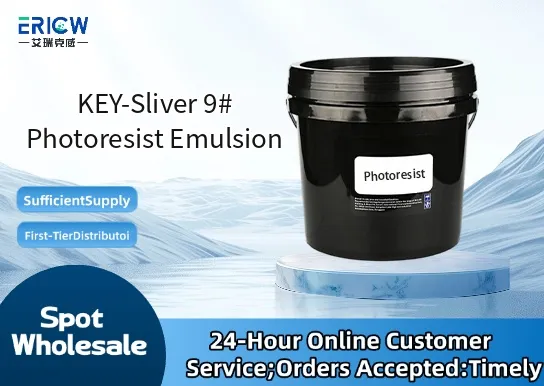
Q1: What is the CAS Registry Number for KEY-Sliver 9# Photoresist Emulsion?
A: KEY-Sliver 9# is a proprietary multi-component formulation; individual CAS numbers are assigned only to major constituents (e.g., novolac resin: 9003-35-4; DNQ: 87-89-8). Full formulation CAS is not assigned per IUPAC guidelines for complex emulsions.
Q2: What is the recommended coating thickness and corresponding spin speed range for optimal resolution?
A: Target dry-film thickness: 1.2–1.8 µm. Achieved via spin coating at 2500–4000 rpm for 30 sec (depending on substrate wettability and viscosity batch variation); pre-bake at 90 °C for 90 sec recommended.
Q3: How does KEY-Sliver 9# compare to conventional solvent-based photoresists in terms of environmental impact and workplace safety?
A: As a water-based emulsion, it eliminates VOC emissions (<0.1 g/L), reduces flammability risk (flash point >93 °C), and lowers occupational exposure limits—no NIOSH respirator required under normal handling conditions.
Q4: Has KEY-Sliver 9# been evaluated for extractables/migration in contact with food packaging substrates?
A: Not certified for direct food contact per FDA 21 CFR or EU 10/2011. It is intended for industrial lithographic use only; migration testing data is not generated for food-contact applications.
Contact With Us:
E-mail: wangxingqiang@ericwchem.com
Have a Questions? Call Us:
Add:
Building A1, Jiete Industrial Park, Huangpu District, Guangzhou City, Guangdong Province, China