English
 Español
 tiếng việt
 русский
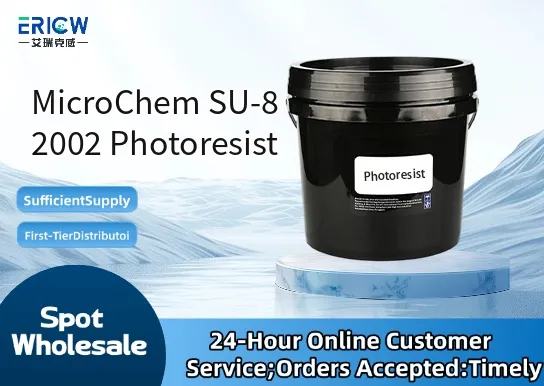
High-resolution negative-tone photolithography with sub-micron resolution capability.
Excellent thermal and chemical resistance after post-exposure bake (PEB) and UV curing.
Low outgassing and minimal shrinkage during processing—ideal for MEMS and high-aspect-ratio structures.
Optimized viscosity (≈2 cP at 25 °C) for spin-coating thin, uniform films (typically 0.5–2 µm).
Stable shelf life when refrigerated (2–8 °C); no pre-filtering required prior to use.
Microelectromechanical systems (MEMS) fabrication, including cantilevers, accelerometers, and microfluidic channels.
Wafer-level packaging and redistribution layer (RDL) patterning in advanced semiconductor interconnects.
Biomedical microdevices such as lab-on-a-chip sensors and microelectrode arrays.
Optical waveguide patterning and photonic integrated circuit (PIC) prototyping.
Direct-write lithography and maskless lithography applications using i-line (365 nm) exposure tools.
| Chemical Type | Epoxy-based negative-tone photoresist |
| Product Form | Liquid solution (in gamma-butyrolactone, GBL) |
| Appearance | Clear, pale yellow to amber liquid |
| Viscosity (25 °C) | 1.9–2.1 cP |
| Primary Applications | Thin-film lithography for MEMS, microfluidics, and photonics |
| Key Features | Low-stress film formation, high adhesion to Si, SiO₂, metal, and glass substrates |
| Benefits | Enables high-fidelity pattern transfer without cracking or delamination in sub-2 µm layers |
| Regulatory Compliance | RoHS 2015/863 compliant; REACH SVHC candidate list screened |
| Common Compatible Systems | Suitability |
| SPIN COATER: Laurell WS-400B-6NPP/LITE | Highly Recommended – Optimized spin parameters pre-validated for uniform 1.0 µm films |
| UV EXPOSURE SYSTEM: Karl Suss MA6 Mask Aligner (i-line, 365 nm) | Highly Recommended – Standard exposure dose: 15–25 mJ/cm² |
| DEVELOPER: MicroChem SU-8 Developer (Propylene Glycol Monomethyl Ether Acetate, PGMEA) | Highly Recommended – Designed for selective dissolution of unexposed resist |
| BAKING SYSTEM: Hotplate (e.g., EVG® 100 series) | Recommended – Precise temperature control essential for post-exposure bake (65–95 °C) |
| WET ETCH STATION: Standard clean benches with N₂ drying | Suitable – Compatible with DI water rinse and low-pressure nitrogen blow-off |
Q1: What is the CAS Registry Number for SU-8 2002?
A: The CAS number for the base epoxy resin component is 121792-25-6; however, SU-8 2002 is a proprietary formulated mixture and does not have a single CAS number. Full composition is available under NDA upon request.
Q2: How much SU-8 2002 is typically consumed per 100 mm wafer at 1.2 µm thickness?
A: Approximately 0.8–1.2 mL per 100 mm wafer (depending on spin speed and acceleration profile); yield improves significantly with automated dispense and edge-bead removal.
Q3: How does SU-8 2002 compare to SU-8 2000.5 or SU-8 2010 in terms of resolution and process window?
A: SU-8 2002 offers superior resolution (<0.8 µm lines/spaces) and wider process latitude vs. SU-8 2000.5 (thicker, lower resolution), while maintaining better coating uniformity than SU-8 2010 due to lower viscosity and optimized solvent balance.
Q4: Is SU-8 2002 compliant with ISO 10993 or USP Class VI for biomedical device fabrication?
A: SU-8 2002 is not certified to ISO 10993 or USP Class VI. For implantable or in-vivo contact applications, users must conduct full biocompatibility testing per intended use; MicroChem provides extractables data sheets upon request.
Q5: Are there known migration or leaching concerns when SU-8 2002 is used in microfluidic devices contacting aqueous biological samples?
A: Fully cured SU-8 2002 exhibits extremely low leachables in aqueous media; however, residual uncured monomer or incomplete crosslinking may cause trace epoxy migration. Strict adherence to recommended PEB (95 °C, 30 min) and UV dose (>20 mJ/cm²) is critical to minimize extractables.
Contact With Us:
E-mail: wangxingqiang@ericwchem.com
Have a Questions? Call Us:
Add:
Building A1, Jiete Industrial Park, Huangpu District, Guangzhou City, Guangdong Province, China